
Join Our JEE Preparation Group
Prep with like-minded aspirants; Get access to free daily tests and study material.
Sign in
Please select an account to continue using cracku.in
↓ →
Join Our JEE Preparation Group
Prep with like-minded aspirants; Get access to free daily tests and study material.
Which one of the following is a chain growth polymerisation?
Polymerisation reactions are classified mainly into two mechanisms.
Step-growth (condensation) polymerisation: Monomers possessing two or more functional groups react step-by-step. Small molecules such as $$H_2O$$, $$HCl$$ etc. are often eliminated. Typical products are proteins, starch, nylon-6,6, polyesters, etc.
Chain-growth (addition) polymerisation: Unsaturated monomers (usually containing $$C=C$$) add to one another through a free-radical, ionic or coordination mechanism. The reaction proceeds via an active centre; high molecular mass polymer is produced rapidly without loss of small molecules. Typical products are polyethylene, polyvinyl chloride, polystyrene, etc.
Now analyse each option:
Option A (Nucleic acid): Formed by condensation of nucleotide units with elimination of $$H_2O$$ ⇒ step-growth.
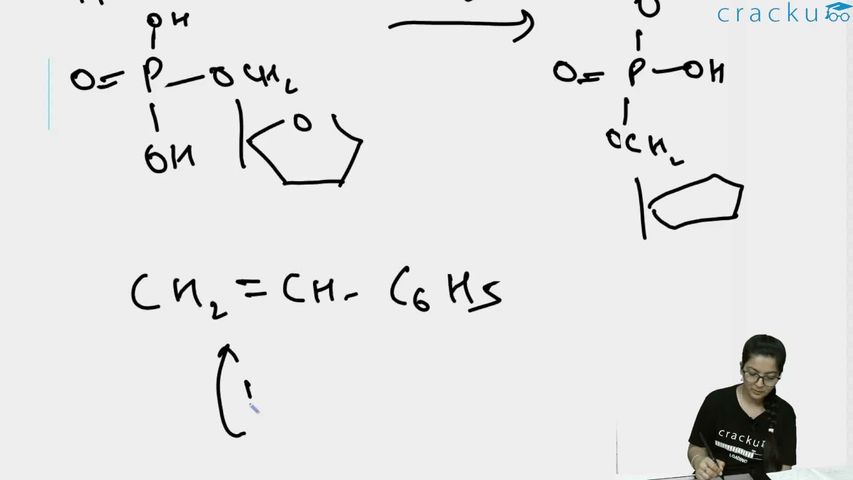
Option B (Polystyrene): Styrene $$CH_2=CH-C_6H_5$$ undergoes free-radical addition to give long chains without elimination of by-products ⇒ chain-growth.
Option C (Protein): Amino acids link through peptide (amide) bonds with loss of $$H_2O$$ ⇒ step-growth.
Option D (Starch): Glucose units join by glycosidic links with elimination of $$H_2O$$ ⇒ step-growth.
Therefore only polystyrene is produced by chain-growth (addition) polymerisation.
Option B which is: Polystyrene
Was this solution helpful?
Click on the Email ☝️ to Watch the Video Solution
Create a FREE account and get:
_1.webp)

Educational materials for JEE preparation

Ask our AI anything

AI can make mistakes. Please verify important information.
AI can make mistakes. Please verify important information.


