
Join Our JEE Preparation Group
Prep with like-minded aspirants; Get access to free daily tests and study material.
Sign in
Please select an account to continue using cracku.in
↓ →
Join Our JEE Preparation Group
Prep with like-minded aspirants; Get access to free daily tests and study material.
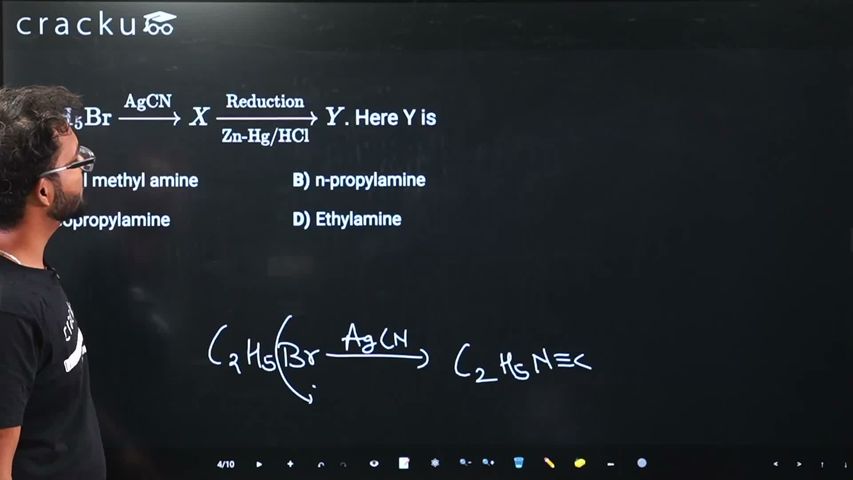
$$\text{C}_2\text{H}_5\text{Br} \xrightarrow{\text{AgCN}} X \xrightarrow[\text{Zn-Hg/HCl}]{\text{Reduction}} Y$$. Here Y is
$$\text{Step 1 : Nucleophilic substitution with AgCN}$$
The salt $$AgCN$$ exists in the covalent form $$Ag-C\!\!\equiv\!\!N$$.
When an alkyl halide is treated with it, substitution occurs through the carbon end of the $$-CN$$ group:
$$C_2H_5Br + Ag-C\!\!\equiv\!\!N \;\longrightarrow\; C_2H_5-N\!\!\equiv\!\!C + AgBr$$
Thus $$X$$ is ethyl isocyanide (ethyl isonitrile), $$C_2H_5NC$$. (With $$KCN$$ the product would have been a nitrile $$C_2H_5CN$$, but with $$AgCN$$ we obtain an isocyanide.)
$$\text{Step 2 : Reduction of the isocyanide}$$
Metal-acid reducing systems such as $$Zn-Hg/HCl$$ add four hydrogens across the $$N\!\!\equiv\!\!C$$ bond of an isocyanide:
$$R-N\!\!\equiv\!\!C + 4\,[H] \;\xrightarrow[\text{HCl}]{Zn\text{-}Hg}\; R-NH-CH_3$$
The carbon of the $$-NC$$ group becomes the methyl group, while the nitrogen becomes part of a secondary amine. Applying this to $$X$$:
$$C_2H_5-N\!\!\equiv\!\!C \;\xrightarrow[\text{HCl}]{Zn\text{-}Hg}\; C_2H_5-NH-CH_3$$
Hence $$Y$$ is ethyl-methylamine, also written as $$C_2H_5NHCH_3$$.
Therefore, the correct option is:
Option A which is: Ethyl methyl amine
Was this solution helpful?
Click on the Email ☝️ to Watch the Video Solution
Create a FREE account and get:
_1.webp)

Educational materials for JEE preparation

Ask our AI anything

AI can make mistakes. Please verify important information.
AI can make mistakes. Please verify important information.


