Join Our JEE Preparation Group
Prep with like-minded aspirants; Get access to free daily tests and study material.
Sign in
Please select an account to continue using cracku.in
↓ →
Join Our JEE Preparation Group
Prep with like-minded aspirants; Get access to free daily tests and study material.
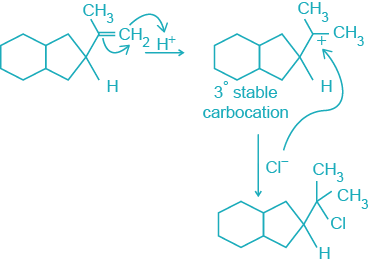
The reaction begins with the generation of an initial carbocation intermediate (typically via the protonation and loss of a leaving group like a hydroxyl group or via electrophilic addition to an alkene). The carbocation forms.
Nucleophilic Attack by Chloride Ion ($$\text{Cl}^\ominus$$):
The chloride ion ($$\text{Cl}^\ominus$$) acts as a nucleophile. It attacks the electron-deficient sp2 hybridized carbocation carbon:
$$\text{R}^\oplus + \text{Cl}^\ominus \rightarrow \text{R--Cl}$$Based on the provided mechanism diagram:
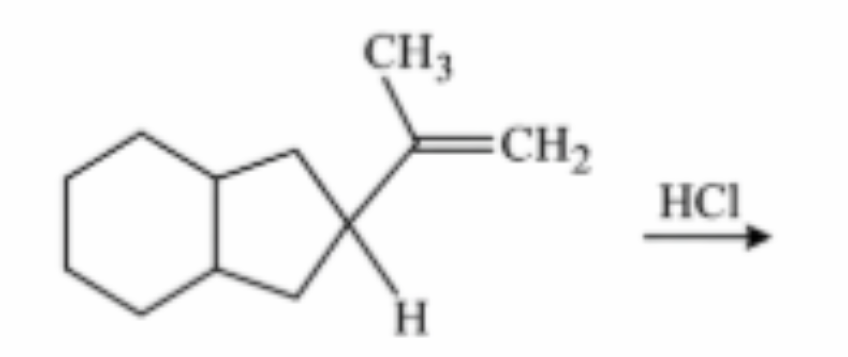
The major product is formed via a thermodynamic pathway favored by the generation of a stable tertiary carbocation intermediate, followed by direct nucleophilic capture by the chloride ion.
Answer: The option corresponding to the structure containing the chlorine atom attached to the tertiary carbon carrying the two methyl groups on the bicyclic framework (Option D).
Was this solution helpful?
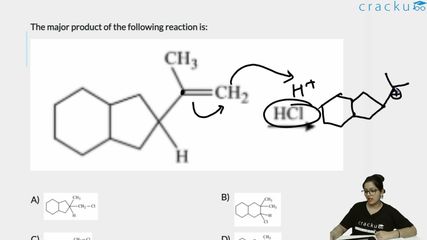
Click on the Email ☝️ to Watch the Video Solution
Create a FREE account and get:
_1.webp)

Educational materials for JEE preparation

Ask our AI anything

AI can make mistakes. Please verify important information.
AI can make mistakes. Please verify important information.