Join WhatsApp Icon JEE WhatsApp Group
Question 53

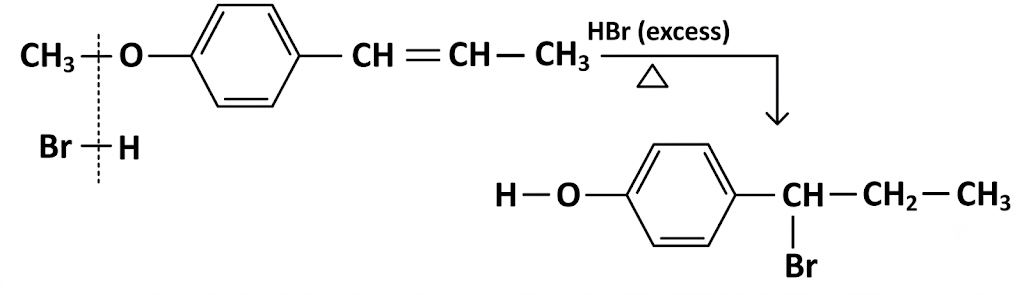
The major product in the following conversion is:

image

We begin with the substrate $$CH_3O{-}C_6H_4{-}CH{=}CH{-}CH_3$$, which contains two functional pieces that can react with hot concentrated hydrobromic acid: the aryl methoxy group and the terminal alkene.

First we consider the behaviour of an aryl methyl ether in strong HX (where $$X=Br$$) at high temperature. The general cleavage reaction is stated below:

$$Ar{-}O{-}CH_3 \;+\; HBr \;\xrightarrow{\text{heat, excess }HBr}\; Ar{-}OH \;+\; CH_3Br$$

In words, hot concentrated hydrobromic acid protonates the ether oxygen, and the methyl group leaves as $$CH_3^+$$ that is immediately trapped by bromide to give $$CH_3Br$$, while the aryl oxygen stays bonded to the ring and is deprotonated later to give a phenolic $$OH$$. Applying this to our molecule we obtain

$$CH_3O{-}C_6H_4{-}CH{=}CH{-}CH_3 \;\longrightarrow\; HO{-}C_6H_4{-}CH{=}CH{-}CH_3$$

Now the product from the ether-cleavage step still possesses the alkene $$CH{=}CH{-}CH_3$$. We must now add the remaining excess $$HBr$$ across this double bond.

The addition of $$HX$$ to an alkene follows the Markovnikov rule, which we now state:

When $$HX$$ adds to an unsymmetrical alkene, the hydrogen goes to the carbon that already has more hydrogens, while the halide goes to the carbon that can best stabilise the positive charge (the one that would bear the carbocation in the intermediate).

In the alkene fragment $$\;{-}CH{=}CH{-}CH_3$$, the left-hand carbon is directly attached to the aromatic ring. If hydrogen adds to the terminal carbon, we create a benzylic carbocation, which is strongly stabilised by resonance with the benzene ring. Writing the step explicitly,

$$HO{-}C_6H_4{-}\underset{\text{benzylic C}}{CH}\!{=}CH{-}CH_3 \;+\; HBr \;\longrightarrow\; HO{-}C_6H_4{-}\underset{\text{benzylic}}{C^+H}\!{-}CH_2{-}CH_3 \;+\; Br^-$$

The benzylic carbocation is superior in stability to the alternative secondary carbocation that would result from putting the positive charge on the terminal carbon, so the Markovnikov pathway is overwhelmingly favoured. The bromide ion now attacks this carbocation, giving

$$HO{-}C_6H_4{-}CH(Br)\,{-}CH_2\,{-}CH_3$$

All algebraic substitutions are complete, and no further rearrangements are possible. Thus the overall major product contains (i) a phenolic $$OH$$ in place of the original $$OCH_3$$ group and (ii) a bromine atom on the benzylic carbon produced by Markovnikov addition.

Hence, the correct answer is Option A.

Get AI Help

Create a FREE account and get:

  • Free JEE Mains Previous Papers PDF
  • Take JEE Mains paper tests

50,000+ JEE Students Trusted Our Score Calculator

Predict your JEE Main percentile, rank & performance in seconds

Ask AI

Ask our AI anything

AI can make mistakes. Please verify important information.