For the following questions answer them individually
Let L, R, C and V represent inductance, resistance, capacitance and voltage, respectively. The dimension of $$\frac{L}{RCV}$$ in SI units will be:
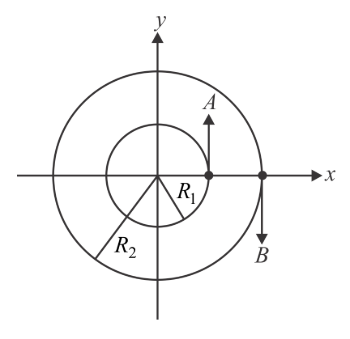
Two particles A, B are moving on two concentric circles of radii $$R_1$$ and $$R_2$$ with equal angular speed $$\omega$$. At $$t = 0$$, their positions and direction of motion are shown in the figure. The relative velocity $$\vec{V_A} - \vec{V_B}$$ at $$t = \frac{\pi}{2\omega}$$ is given by:
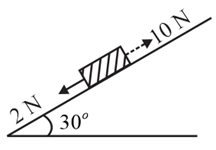
A block kept on a rough inclined plane, as shown in the figure, remains at rest upto a maximum force 2N down the inclined plane. The maximum external force up the inclined plane that does not move the block is 10N. The coefficient of static friction between the block and the plane is: [Take $$g = 10$$ m/s$$^2$$]
A vertical closed cylinder is separated into two parts by a frictionless piston of mass m and of negligible thickness. The piston is free to move along the length of the cylinder. The length of the cylinder above piston is $$l_1$$, and that below the piston is $$l_2$$, such that $$l_1 > l_2$$. Each part of the cylinder contains n moles of an ideal gas at equal temperature T. If the piston is stationary, its mass m will be given by: (R is universal gas constant and g is the acceleration due to gravity)
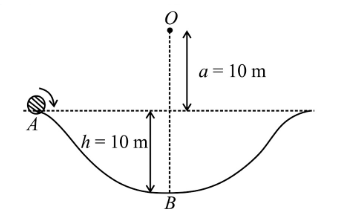
A particle of mass 20 g is released with an initial velocity 5 m s$$^{-1}$$ along the curve from the point A, as shown in the figure. The point A is at height h from point B. The particle slides along the frictionless surface. When the particle reaches point B, its angular momentum about O will be: (Take $$g = 10$$ m s$$^{-2}$$)
An alpha-particle of mass m suffers 1-dimensional elastic collision with a nucleus at rest of unknown mass. It is scattered directly backwards losing 64% of its initial kinetic energy. The mass of the nucleus is
A long cylindrical vessel is half filled with a liquid. When the vessel is rotated about its own vertical axis, the liquid rises up near the wall. If the radius of vessel is 5 cm and its rotational speed is 2 rotations per second, then the difference in the heights between the center and the sides, in cm, will be:
The moment of inertia of a solid sphere, about an axis parallel to its diameter and at a distance of x from it, is $$I(x)$$. Which one of the graphs represents the variation of $$I(x)$$ with x correctly?
Two satellites, A and B, have masses m and 2m respectively. A is in a circular orbit of radius R and B is in a circular orbit of radius 2R around the earth. The ratio of their kinetic energies, $$\frac{K_A}{K_B}$$ is:
A soap bubble, blown by a mechanical pump at the mouth of a tube increases in volume with time at a constant rate. The graph that correctly depicts the time dependence of pressure inside the bubble is given by: