
Join Our JEE Preparation Group
Prep with like-minded aspirants; Get access to free daily tests and study material.
Sign in
Please select an account to continue using cracku.in
↓ →
Join Our JEE Preparation Group
Prep with like-minded aspirants; Get access to free daily tests and study material.
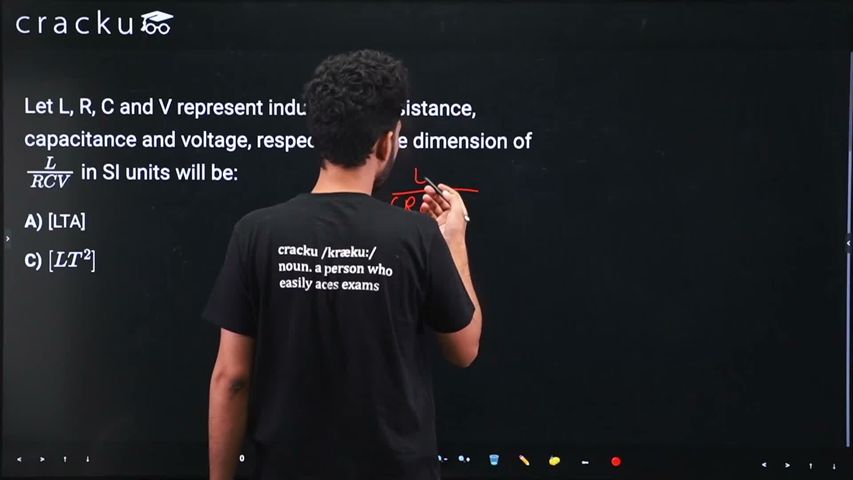
Let L, R, C and V represent inductance, resistance, capacitance and voltage, respectively. The dimension of $$\frac{L}{RCV}$$ in SI units will be:
We have to find the dimensions, in SI base units, of the quantity $$\dfrac{L}{R\,C\,V}$$, where the symbols carry their usual electrical meanings. Dimensional analysis proceeds by writing each physical quantity in terms of the fundamental dimensions $$[M]$$ for mass, $$[L]$$ for length, $$[T]$$ for time and $$[A]$$ for electric current.
First, consider inductance $$L$$. From the definition $$E = L\dfrac{dI}{dt}$$, the inductance is $$L = \dfrac{E}{dI/dt}$$. The electromotive force (emf) or voltage $$E$$ has the dimension of voltage $$V$$, which we shall obtain separately, while current has the dimension $$[A]$$. Carrying out the division gives
$$[L] = [M\,L^{2}\,T^{-2}\,A^{-2}].$$
Next, resistance $$R$$ is defined by Ohm’s law $$V = I\,R$$, so $$R = \dfrac{V}{I}$$. Dividing the voltage dimension by current gives
$$[R] = [M\,L^{2}\,T^{-3}\,A^{-2}].$$
Capacitance $$C$$ follows from the relation $$Q = C\,V$$, so $$C = \dfrac{Q}{V}$$. Charge has the dimension $$[A\,T]$$. Substituting the voltage dimension (derived just below) and simplifying yields
$$[C] = [M^{-1}\,L^{-2}\,T^{4}\,A^{2}].$$
Voltage $$V$$ itself can be expressed from the work-charge relation $$V = \dfrac{W}{Q}$$. Work or energy has the mechanical dimension $$[M\,L^{2}\,T^{-2}]$$, and dividing by charge $$[A\,T]$$ produces
$$[V] = [M\,L^{2}\,T^{-3}\,A^{-1}].$$
Now we combine the dimensions of the three quantities in the denominator:
$$[R\,C\,V] = [R]\,[C]\,[V]$$
$$= [M^{1}L^{2}T^{-3}A^{-2}] \cdot [M^{-1}L^{-2}T^{4}A^{2}] \cdot [M^{1}L^{2}T^{-3}A^{-1}]$$
Multiplying adds the exponents of corresponding fundamental quantities, giving
$$[R\,C\,V] = [M^{(1-1+1)}\,L^{(2-2+2)}\,T^{(-3+4-3)}\,A^{(-2+2-1)}] = [M^{1}\,L^{2}\,T^{-2}\,A^{-1}].$$
Finally, we divide the dimension of inductance by this combined dimension:
$$\left[\dfrac{L}{R\,C\,V}\right] = \dfrac{[M^{1}\,L^{2}\,T^{-2}\,A^{-2}]}{[M^{1}\,L^{2}\,T^{-2}\,A^{-1}]}$$
Subtracting the exponents (numerator minus denominator) for each fundamental quantity, we get
$$[M^{0}\,L^{0}\,T^{0}\,A^{-1}] = [A^{-1}].$$
All mass, length and time factors cancel out, leaving only $$A^{-1}$$. Hence, the correct answer is Option B.
Was this solution helpful?
Click on the Email ☝️ to Watch the Video Solution
Create a FREE account and get:
_1.webp)

Educational materials for JEE preparation

Ask our AI anything

AI can make mistakes. Please verify important information.
AI can make mistakes. Please verify important information.


