
Join Our JEE Preparation Group
Prep with like-minded aspirants; Get access to free daily tests and study material.
Sign in
Please select an account to continue using cracku.in
↓ →
Join Our JEE Preparation Group
Prep with like-minded aspirants; Get access to free daily tests and study material.
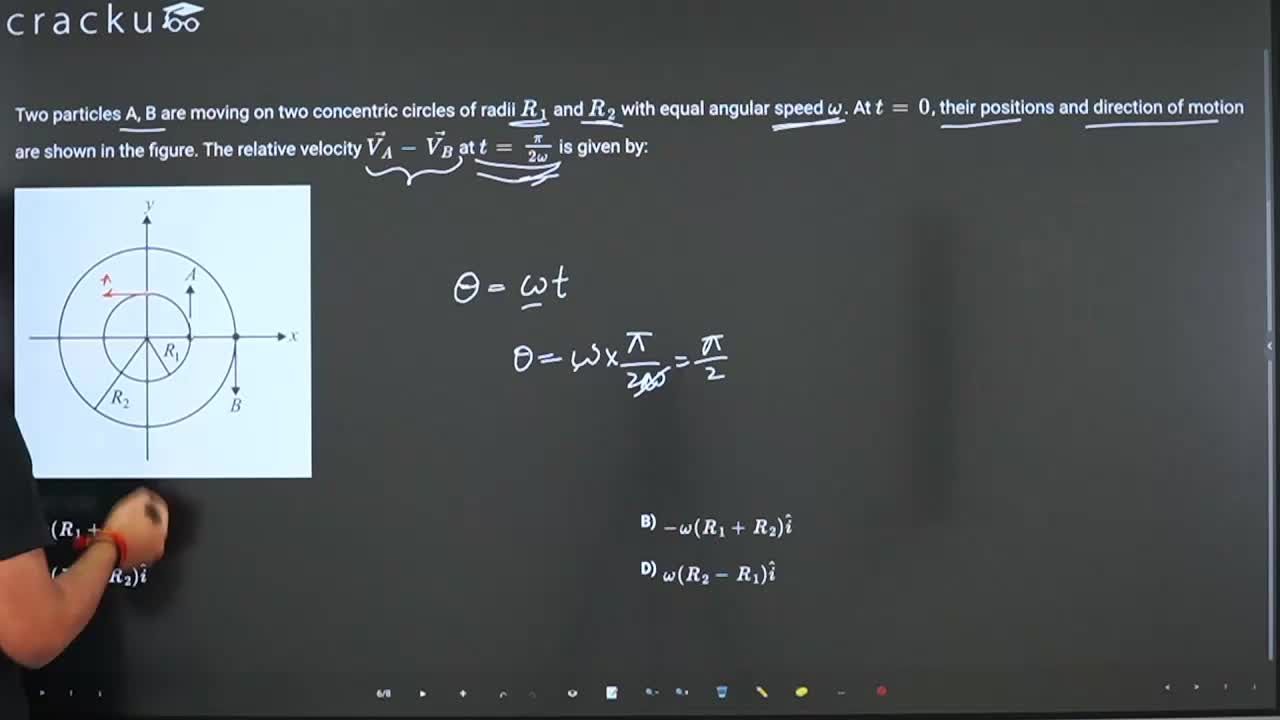
Two particles A, B are moving on two concentric circles of radii $$R_1$$ and $$R_2$$ with equal angular speed $$\omega$$. At $$t = 0$$, their positions and direction of motion are shown in the figure. The relative velocity $$\vec{V_A} - \vec{V_B}$$ at $$t = \frac{\pi}{2\omega}$$ is given by:
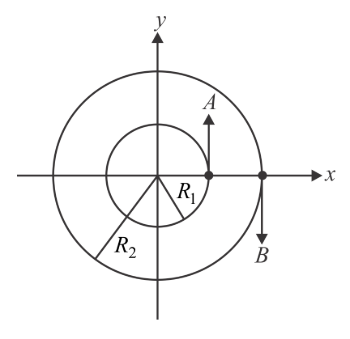
For the angular displacement of both particles in time $$t = \frac{\pi}{2\omega}$$:
$$\theta = \omega t = \omega \left(\frac{\pi}{2\omega}\right) = \frac{\pi}{2}\text{ rad} = 90^\circ$$
For particle A (initially at $$(R_1, 0)$$ moving in the counter-clockwise direction along $$+\hat{j}$$):
$$\text{After rotating by } 90^\circ\text{, its position is on the positive y-axis, and its velocity points along } -\hat{i}:$$
$$\vec{V}_A = -\omega R_1 \hat{i}$$
For particle B (initially at $$(R_2, 0)$$ moving in the clockwise direction along $$-\hat{j}$$):
$$\text{After rotating by } 90^\circ\text{, its position is on the negative y-axis, and its velocity points along } -\hat{i}:$$
$$\vec{V}_B = -\omega R_2 \hat{i}$$
For relative velocity $$\vec{V}_A - \vec{V}_B$$:
$$\vec{V}_A - \vec{V}_B = (-\omega R_1 \hat{i}) - (-\omega R_2 \hat{i}) = \omega(R_2 - R_1)\hat{i}$$
Was this solution helpful?
Click on the Email ☝️ to Watch the Video Solution
Create a FREE account and get:
_1.webp)

Educational materials for JEE preparation

Ask our AI anything

AI can make mistakes. Please verify important information.
AI can make mistakes. Please verify important information.


