NTA JEE Main 12th January 2019 Shift 2
For the following questions answer them individually
NTA JEE Main 12th January 2019 Shift 2 - Question 11
An ideal gas is enclosed in a cylinder at pressure of 2 atm and temperature, 300 K. The mean time between two successive collisions is $$6 \times 10^{-8}$$ s. If the pressure is doubled and temperature is increased to 500 K, the mean time between two successive collisions will be close to:
NTA JEE Main 12th January 2019 Shift 2 - Question 12
A simple harmonic motion is represented by: $$y = 5(\sin 3\pi t + \sqrt{3} \cos 3\pi t)$$ cm. The amplitude and time period of the motion are:
NTA JEE Main 12th January 2019 Shift 2 - Question 13
A resonance tube is old and has a jagged end. It is still used in the laboratory to determine the velocity of sound in air. A tuning fork of frequency 512 Hz produces first resonance when the tube is filled with water to a mark 11 cm below a reference mark, near the open end of the tube. The experiment is repeated with another fork of frequency 256 Hz which produces first resonance when water reaches a mark 27 cm below the reference mark. The velocity of sound in air, obtained in the experiment, is close to

NTA JEE Main 12th January 2019 Shift 2 - Question 14
A parallel plate capacitor with plates of area 1 m$$^2$$ each, are at a separation of 0.1 m. If the electric field between the plates is 100 N/C, the magnitude of charge on each plate is: (Take $$\epsilon_0 = 8.85 \times 10^{-12} \frac{C^2}{N \cdot m^2}$$)
NTA JEE Main 12th January 2019 Shift 2 - Question 15
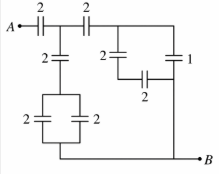
In the circuit shown, find C if the effective capacitance of the whole circuit is to be 0.5 $$\mu F$$. All values in the circuit are in $$\mu F$$.
NTA JEE Main 12th January 2019 Shift 2 - Question 16
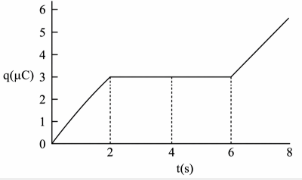
The charge on a capacitor plate in a circuit, as a function of time, is shown in the figure. What is the value of current at $$t = 4$$ s?
NTA JEE Main 12th January 2019 Shift 2 - Question 17
A galvanometer, whose resistance is 50 ohm, has 25 divisions in it. When a current of $$4 \times 10^{-4}$$ A passes through it, its needle (pointer) deflects by one division. To use this galvanometer as a voltmeter of range 2.5 V it should be connected to a resistance of:
NTA JEE Main 12th January 2019 Shift 2 - Question 18
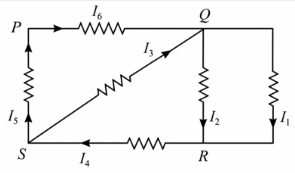
In the given circuit diagram, the currents, $$I_1 = -0.3$$ A, $$I_4 = 0.8$$ A and $$I_5 = 0.4$$ A, are flowing as shown. The currents $$I_2$$, $$I_3$$ and $$I_6$$, respectively, are:
NTA JEE Main 12th January 2019 Shift 2 - Question 19
A paramagnetic material has $$10^{28}$$ atoms m$$^{-3}$$. Its magnetic susceptibility at temperature 350 K is $$2.8 \widetilde{A} \times 10^{-4}$$. Its susceptibility at 300 K is
NTA JEE Main 12th January 2019 Shift 2 - Question 20
A 10 m long horizontal wire extends from North East to South West. It is falling with a speed of 5.0 m s$$^{-1}$$, at right angles to the horizontal component of the earth's magnetic field of $$0.3 \times 10^{-4}$$ Wb m$$^{-2}$$. The value of the induced emf in the wire is: