
Join Our JEE Preparation Group
Prep with like-minded aspirants; Get access to free daily tests and study material.
Sign in
Please select an account to continue using cracku.in
↓ →
Join Our JEE Preparation Group
Prep with like-minded aspirants; Get access to free daily tests and study material.
A particle of mass 20 g is released with an initial velocity 5 m s$$^{-1}$$ along the curve from the point A, as shown in the figure. The point A is at height h from point B. The particle slides along the frictionless surface. When the particle reaches point B, its angular momentum about O will be: (Take $$g = 10$$ m s$$^{-2}$$)
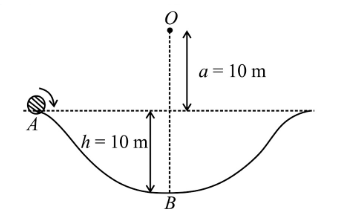
Velocity at Point B:
Using conservation of energy between point A and point B:
$$\frac{1}{2}mv_A^2 + mgh = \frac{1}{2}mv_B^2$$
$$v_B = \sqrt{v_A^2 + 2gh}$$
$$v_B = \sqrt{5^2 + 2(10)(10)} = 15 \text{ m s}^{-1}$$
Angular Momentum about O:
The perpendicular distance from point O to the horizontal velocity vector at B is:
$$r_{\perp} = a + h$$ = 10 + 10 = 20 m
$$L_O = m \cdot v_B \cdot r_{\perp}$$
$$L_O = 0.02 \times 15 \times 20$$
$$L_O = 6 \text{ kg m}^2 \text{ s}^{-1}$$
Was this solution helpful?
Click on the Email ☝️ to Watch the Video Solution
Create a FREE account and get:
_1.webp)

Educational materials for JEE preparation

Ask our AI anything

AI can make mistakes. Please verify important information.
AI can make mistakes. Please verify important information.


