
Join Our JEE Preparation Group
Prep with like-minded aspirants; Get access to free daily tests and study material.
Sign in
Please select an account to continue using cracku.in
↓ →
Join Our JEE Preparation Group
Prep with like-minded aspirants; Get access to free daily tests and study material.
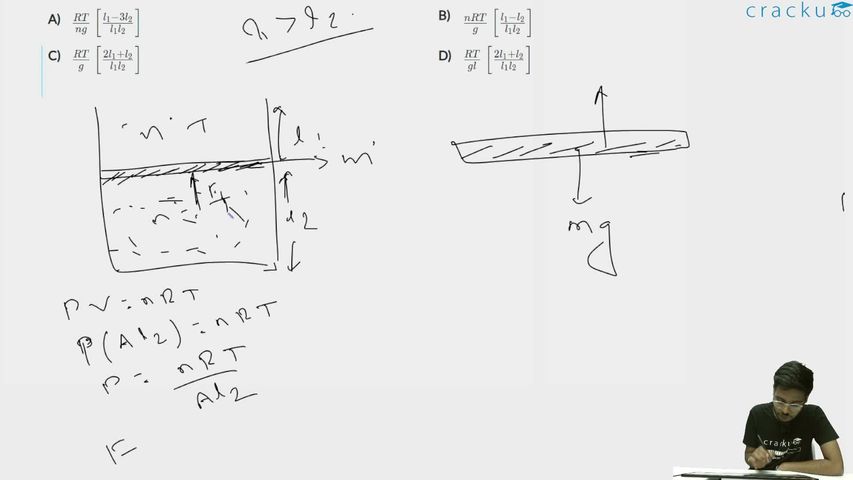
A vertical closed cylinder is separated into two parts by a frictionless piston of mass m and of negligible thickness. The piston is free to move along the length of the cylinder. The length of the cylinder above piston is $$l_1$$, and that below the piston is $$l_2$$, such that $$l_1 > l_2$$. Each part of the cylinder contains n moles of an ideal gas at equal temperature T. If the piston is stationary, its mass m will be given by: (R is universal gas constant and g is the acceleration due to gravity)
We have a vertical cylinder of uniform cross-sectional area $$A$$. A light, frictionless piston of mass $$m$$ separates the cylinder into an upper part of length $$l_1$$ and a lower part of length $$l_2$$, with $$l_1 > l_2$$. Each part contains $$n$$ moles of an ideal gas at the same absolute temperature $$T$$. Because the piston is at rest, the forces acting on it must balance perfectly.
For each gas sample we write the ideal-gas equation. The ideal-gas law states
$$PV = nRT,$$
where $$P$$ is pressure, $$V$$ is volume, $$n$$ is the number of moles, $$R$$ is the universal gas constant and $$T$$ is the absolute temperature.
First for the gas above the piston, whose pressure is $$P_1$$ and volume is $$V_1 = A\,l_1$$, we obtain
$$P_1 V_1 = nRT \;\;\Longrightarrow\;\; P_1 (A\,l_1) = nRT \;\;\Longrightarrow\;\; P_1 = \frac{nRT}{A\,l_1}.$$
Next for the gas below the piston, whose pressure is $$P_2$$ and volume is $$V_2 = A\,l_2$$, we write
$$P_2 V_2 = nRT \;\;\Longrightarrow\;\; P_2 (A\,l_2) = nRT \;\;\Longrightarrow\;\; P_2 = \frac{nRT}{A\,l_2}.$$
Now we look at the forces acting on the piston. The upward force on the piston is the pressure exerted by the lower gas times area $$A$$, namely $$P_2A$$. The downward forces are the pressure exerted by the upper gas, $$P_1A$$, and the weight of the piston, $$mg$$. For mechanical equilibrium (piston stationary) we therefore set
$$\text{Upward force} = \text{Downward force}$$
$$P_2A = P_1A + mg.$$
Solving for the weight term, we write
$$mg = A\,(P_2 - P_1).$$
We now substitute the expressions for $$P_1$$ and $$P_2$$ obtained from the ideal-gas law:
$$mg = A\!\left(\frac{nRT}{A\,l_2} - \frac{nRT}{A\,l_1}\right).$$
The area $$A$$ cancels out:
$$mg = nRT\!\left(\frac{1}{l_2} - \frac{1}{l_1}\right).$$
We combine the fractions inside the parentheses:
$$\frac{1}{l_2} - \frac{1}{l_1} = \frac{l_1 - l_2}{l_1\,l_2}.$$
Substituting this result gives
$$mg = nRT\!\left(\frac{l_1 - l_2}{l_1\,l_2}\right).$$
Finally we isolate the mass $$m$$ by dividing both sides by $$g$$:
$$m = \frac{nRT}{g}\!\left(\frac{l_1 - l_2}{l_1\,l_2}\right).$$
This expression matches option B.
Hence, the correct answer is Option B.
Was this solution helpful?
Click on the Email ☝️ to Watch the Video Solution
Create a FREE account and get:
_1.webp)

Educational materials for JEE preparation

Ask our AI anything

AI can make mistakes. Please verify important information.
AI can make mistakes. Please verify important information.


