Join Our JEE Preparation Group
Prep with like-minded aspirants; Get access to free daily tests and study material.
Sign in
Please select an account to continue using cracku.in
↓ →
Join Our JEE Preparation Group
Prep with like-minded aspirants; Get access to free daily tests and study material.
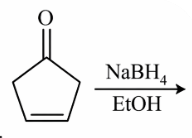
We are given the substrate cyclopentanone, which is a five-membered cyclic ketone having the carbonyl group $$\gt \! C = O$$ at one of the ring carbons. The reagent set is sodium borohydride in ethanol, written as $$NaBH_4/EtOH.$$
First, we recall the general reduction formula for a ketone by sodium borohydride. The well-known relationship is
$$R_2C=O \;+\; NaBH_4 \;\overset{\text{protic solvent}}{\rightarrow} \; R_2C(OH)H.$$
Stated in words, NaBH4 delivers a hydride ion $$H^-$$ to the electrophilic carbonyl carbon, converting the $$C=O$$ into an alkoxide $$C-O^-. $$ The protic solvent (here ethanol) then protonates that alkoxide to give the corresponding alcohol.
Applying this step by step to cyclopentanone, we have
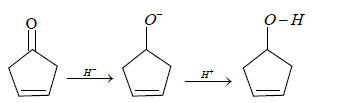
1. Hydride addition:
$$ \underset{\text{cyclopentanone}}{C_5H_8O} \;+\; BH_4^{-} \;\longrightarrow\; \underset{\text{alkoxide}}{C_5H_9O^{-}} \;+\; BH_3$$
2. Protonation by ethanol (the solvent is an available proton donor):
$$ C_5H_9O^- \;+\; EtOH \;\longrightarrow\; C_5H_{10}O \;+\; EtO^- $$
Combining the two stages, the net result is conversion of the ketone functional group into a single hydroxyl group without adding any other substituent. Therefore the ring now bears an $$-OH$$ at the same carbon that formerly possessed the carbonyl.
So we obtain cyclopentanol, a secondary alcohol in a five-membered ring, and nothing else such as an $$-OEt$$ group or a double bond is introduced. Among the listed choices, the structure that matches is simply “Cyclopentanol.”
Hence, the correct answer is Option C.
Was this solution helpful?
Click on the Email ☝️ to Watch the Video Solution
Create a FREE account and get:
_1.webp)

Educational materials for JEE preparation

Ask our AI anything

AI can make mistakes. Please verify important information.
AI can make mistakes. Please verify important information.