
Join Our JEE Preparation Group
Prep with like-minded aspirants; Get access to free daily tests and study material.
Sign in
Please select an account to continue using cracku.in
↓ →
Join Our JEE Preparation Group
Prep with like-minded aspirants; Get access to free daily tests and study material.
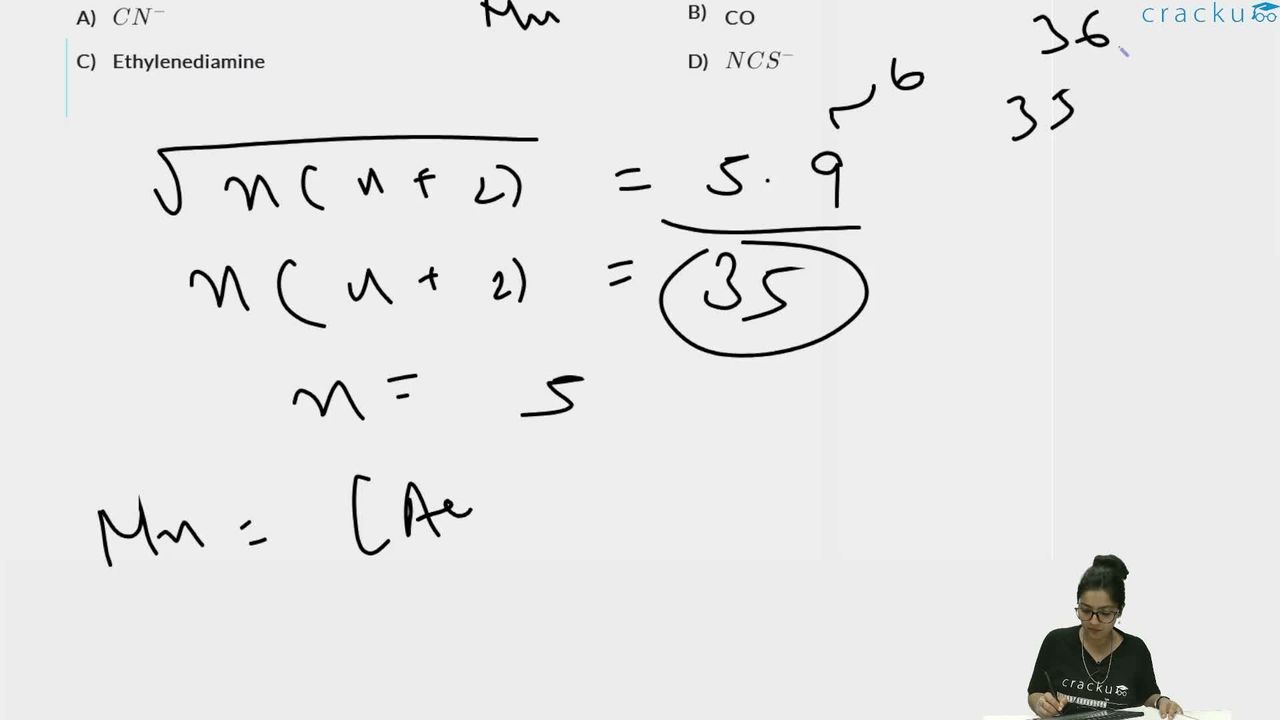
The magnetic moment of an octahedral homoleptic Mn(II) complex is 5.9 B.M. The suitable ligand for this complex is:
We start with the information that the complex is an octahedral homoleptic Mn(II) species and its measured magnetic moment is $$5.9\ \text{B.M.}$$
First, recall the spin-only magnetic-moment formula for transition-metal complexes:
$$\mu_{\text{spin only}}=\sqrt{n(n+2)}\ \text{B.M.}$$
Here, $$n$$ denotes the number of unpaired electrons present in the metal ion inside the complex.
We have an experimental value $$\mu=5.9\ \text{B.M.}$$ We set this equal to the formula and solve for $$n$$:
$$5.9\approx\sqrt{n(n+2)}$$
Squaring both sides, we obtain
$$5.9^{2}\approx n(n+2)$$
$$34.81\approx n^{2}+2n$$
Rewriting,
$$n^{2}+2n-34.81\approx0$$
We test integral values close to the square root of 34.81. Putting $$n=5$$ gives
$$5^{2}+2(5)=25+10=35$$
This value, $$35$$, is almost exactly the left-hand side $$34.81$$, confirming that
$$n=5$$
Thus the complex contains five unpaired electrons.
Next, let us analyze what five unpaired electrons mean for Mn(II). In the +2 oxidation state, manganese has the electron configuration
$$\text{Mn}^{2+}:\;[Ar]\,3d^{5}$$
Within an octahedral field there are two possibilities:
1) A high-spin configuration $$t_{2g}^{3}e_{g}^{2}$$ (five unpaired electrons).
2) A low-spin configuration $$t_{2g}^{5}e_{g}^{0}$$ (one unpaired electron).
The observed value of $$n=5$$ clearly matches the high-spin situation. Therefore, the ligand present in the complex must be a weak-field ligand, so that the crystal-field splitting energy $$\Delta_{0}$$ is small and pairing of electrons does not occur.
Now we classify each ligand given in the options according to the spectrochemical series (weak field on the left, strong field on the right):
$$I^- < Br^- < S^{2-} < SCN^- (as NCS^-) < Cl^- < F^- < OH^- < H_2O < NCS^- (as SCN^-) < en < NH_3 < CN^- < CO$$
From this ordering we see:
• $$CN^-$$ and CO are very strong-field ligands - they would force a low-spin configuration and cannot give $$n=5$$.
• Ethylenediamine (en) is a moderately strong-field ligand, also tending toward low spin for a d5 ion.
• $$NCS^-$$ (coordinating through nitrogen, written as NCS-) is a comparatively weak-field ligand - it will leave Mn(II) in the high-spin state with five unpaired electrons.
Because only a weak-field ligand is compatible with the experimentally observed magnetic moment, the correct choice is $$NCS^-$$.
Hence, the correct answer is Option D.
Was this solution helpful?
Click on the Email ☝️ to Watch the Video Solution
Create a FREE account and get:
_1.webp)

Educational materials for JEE preparation

Ask our AI anything

AI can make mistakes. Please verify important information.
AI can make mistakes. Please verify important information.


