
Join Our JEE Preparation Group
Prep with like-minded aspirants; Get access to free daily tests and study material.
Sign in
Please select an account to continue using cracku.in
↓ →
Join Our JEE Preparation Group
Prep with like-minded aspirants; Get access to free daily tests and study material.
The reaction of chlorine gas with sodium hydroxide is a classic example of a disproportionation reaction (also known as a self-redox reaction). In this type of reaction, the exact same element (chlorine) is simultaneously oxidized to a higher oxidation state and reduced to a lower oxidation state.
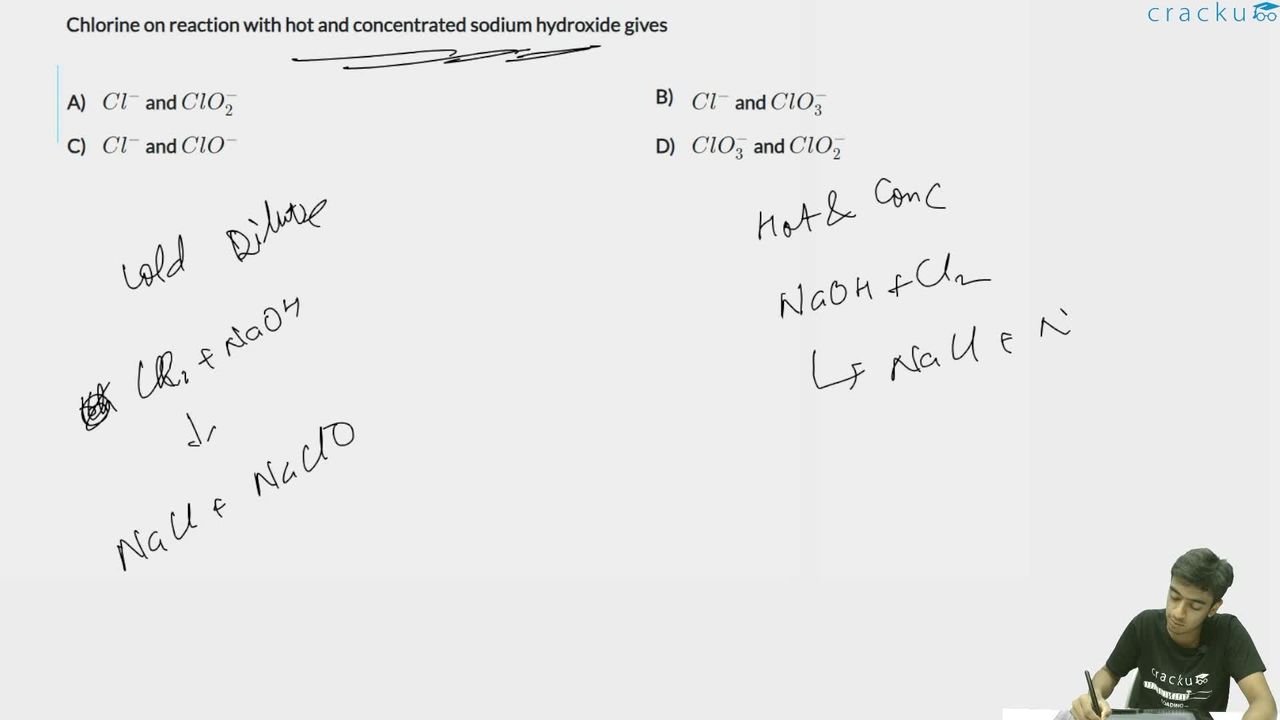
When chlorine gas (Cl2) reacts with hot and concentrated sodium hydroxide (NaOH), it undergoes a deep oxidation-reduction process to form sodium chloride, sodium chlorate, and water.
The balanced molecular equation is: 3 Cl2 + 6 NaOH -> 5 NaCl + NaClO3 + 3 H2O
The ionic form of the products focuses on the anions released in solution:
Let us look at what happens to the oxidation states of the chlorine atoms:
It is helpful to contrast this with the other common exam condition to avoid confusion:
Was this solution helpful?
Click on the Email ☝️ to Watch the Video Solution
Create a FREE account and get:
_1.webp)

Educational materials for JEE preparation

Ask our AI anything

AI can make mistakes. Please verify important information.
AI can make mistakes. Please verify important information.


