
Join Our JEE Preparation Group
Prep with like-minded aspirants; Get access to free daily tests and study material.
Sign in
Please select an account to continue using cracku.in
↓ →
Join Our JEE Preparation Group
Prep with like-minded aspirants; Get access to free daily tests and study material.
Arrange the following carbanions in the decreasing order of stability.
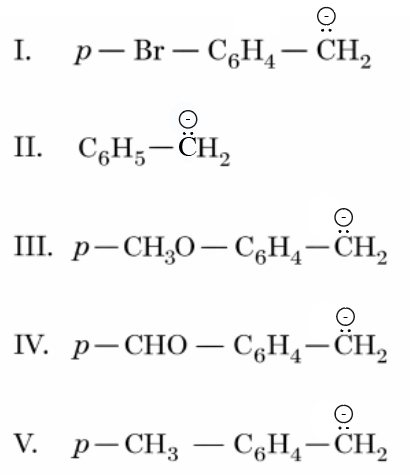
Choose the correct answer from the options given below:
Stability of a carbanion is governed mainly by three factors:
• Delocalisation (resonance or aromaticity) that can spread the negative charge.
• Presence of strong -I / -M groups (carbonyl, $$NO_2$$, $$CN$$, halogens, etc.) that withdraw electron density and lower the charge density on carbon.
• Hybridisation of the charged carbon: $$sp \;(\text{50 % }s) \gt sp^{2} \;(\text{33 % }s) \gt sp^{3} \;(\text{25 % }s)$$ because higher s-character holds electrons closer to the nucleus.
The five carbanions given in the question are represented schematically below (labels as per the paper):
I. $$\ce{Ph-CH2^{-}}$$ (benzylic)
II. $$\ce{CH2=CH-CH2^{-}}$$ (allylic)
III. $$\ce{(CH3)3C^{-}}$$ (tert-butyl carbanion, simple alkyl, no stabilisation)
IV. $$\ce{^-C(COOR)=C(COOR)2}$$ (anion flanked by two ester / carbonyl groups; resonance with two $$C=O$$ units)
V. $$\ce{CH3-CH2^{-}}$$ (primary alkyl)
Now examine each structure one by one.
Case IV:The negative charge on carbon is adjacent to two carbonyl groups. It can delocalise into both of them, giving resonance forms like $$\ce{^-C(COOR)=C(COOR)2 \rightleftharpoons O=C(-O R)-C=C(-O R)2^{-}}$$ Hence the charge is shared among three electronegative oxygen atoms in several canonical forms. The -I and -M effects of the carbonyls further pull electron density away. This combination makes IV the most stable.
Case I:Benzylic carbanion $$\ce{Ph-CH2^{-}}$$ can resonate with the aromatic ring, distributing the negative charge over ortho and para positions of the benzene nucleus. Six equivalent resonance structures are possible, so I is highly stabilised, but less than IV because delocalisation is only onto $$sp^{2}$$ carbons, not electronegative oxygens.
Case II:Allylic carbanion $$\ce{CH2=CH-CH2^{-}}$$ has two resonance structures: $$\ce{CH2=CH-CH2^{-} \rightleftharpoons ^-CH2-CH=CH2}$$ Delocalisation is limited to two $$sp^{2}$$ carbons; no electronegative atoms participate. Hence II is stabilised, but weaker than I.
Case V:Primary alkyl carbanion $$\ce{CH3-CH2^{-}}$$ is an $$sp^{3}$$ carbanion with no resonance and only a weak inductive effect from one methyl group (actually destabilising). It is therefore much less stable than the allylic system.
Case III:Tert-butyl carbanion $$\ce{(CH3)3C^{-}}$$ has three electron-donating methyl groups that intensify the negative charge (hyperconjugation works in reverse for carbanions and is destabilising). It is also $$sp^{3}$$ and completely localised; hence it is the least stable of the lot.
Combining the above discussions, the decreasing order of stability is:
$$\text{IV} \gt \text{I} \gt \text{II} \gt \text{V} \gt \text{III}$$
Therefore, the correct choice is
Option D which is: IV > I > II > V > III.
Was this solution helpful?
Create a FREE account and get:
_1.webp)

Educational materials for JEE preparation

Ask our AI anything

AI can make mistakes. Please verify important information.
AI can make mistakes. Please verify important information.
