
Join Our JEE Preparation Group
Prep with like-minded aspirants; Get access to free daily tests and study material.
Sign in
Please select an account to continue using cracku.in
↓ →
Join Our JEE Preparation Group
Prep with like-minded aspirants; Get access to free daily tests and study material.
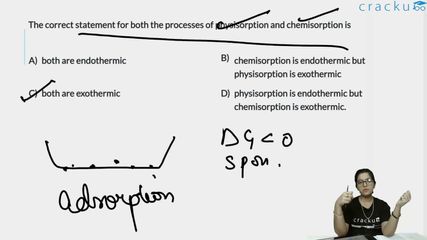
Adsorption means adherence of molecules from the bulk (gas / solution) on the surface of a solid. For any spontaneous adsorption process the Gibbs free-energy change $$\Delta G$$ must be negative:
$$\Delta G = \Delta H - T\Delta S \lt 0$$
The adsorbate particles lose translational freedom when they stick to a surface, so the entropy change $$\Delta S$$ is negative. For $$\Delta G$$ to remain negative, the enthalpy change $$\Delta H$$ must therefore be negative, i.e. heat must be released. Hence any spontaneous adsorption is an exothermic process.
• Physisorption (physical adsorption) involves weak van der Waals forces. Its heat of adsorption is small, typically $$20\text{-}40\;{\rm kJ\,mol^{-1}}$$, but still negative.
• Chemisorption (chemical adsorption) involves formation of chemical bonds with the surface. The heat of adsorption is much larger, often $$80\text{-}200\;{\rm kJ\,mol^{-1}}$$, yet again negative.
Thus, in both physisorption and chemisorption the enthalpy change is negative; they are exothermic.
Therefore the correct statement is:
Option C which is: both are exothermic
Was this solution helpful?
Click on the Email ☝️ to Watch the Video Solution
Create a FREE account and get:
_1.webp)

Educational materials for JEE preparation

Ask our AI anything

AI can make mistakes. Please verify important information.
AI can make mistakes. Please verify important information.
