
Join Our JEE Preparation Group
Prep with like-minded aspirants; Get access to free daily tests and study material.
Sign in
Please select an account to continue using cracku.in
↓ →
Join Our JEE Preparation Group
Prep with like-minded aspirants; Get access to free daily tests and study material.
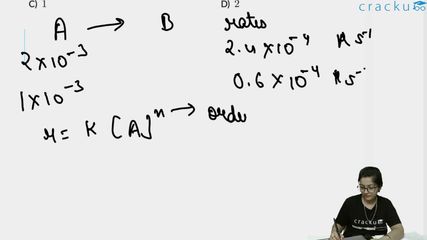
In a chemical reaction $$A$$ is converted into $$B$$. The rates of reaction, starting with initial concentrations of $$A$$ as $$2\times 10^{-3}$$ M and $$1\times 10^{-3}$$ M, are equal to $$2.40\times 10^{-4}$$ Ms$$^{-1}$$ and $$0.60\times 10^{-4}$$ Ms$$^{-1}$$ respectively. The order of reaction with respect to reactant $$A$$ will be
For any reaction whose rate depends only on the concentration of reactant $$A$$, the rate law can be written as
$$r = k [A]^{\,n}$$
where $$k$$ is the rate constant and $$n$$ is the order of the reaction with respect to $$A$$.
Two experiments are provided:
Experiment 1: $$[A]_1 = 2\times10^{-3}\,\text{M}$$, $$r_1 = 2.40\times10^{-4}\,\text{M s}^{-1}$$
Experiment 2: $$[A]_2 = 1\times10^{-3}\,\text{M}$$, $$r_2 = 0.60\times10^{-4}\,\text{M s}^{-1}$$
Divide the rate expressions for the two experiments to eliminate $$k$$:
$$\frac{r_1}{r_2} \;=\; \frac{k [A]_1^{\,n}}{k [A]_2^{\,n}} \;=\; \left(\frac{[A]_1}{[A]_2}\right)^{\!n}$$
Insert the numerical values:
$$\frac{2.40\times10^{-4}}{0.60\times10^{-4}} \;=\; \left(\frac{2\times10^{-3}}{1\times10^{-3}}\right)^{\!n}$$
$$4 = 2^{\,n}$$
Since $$2^{\,2}=4$$, we obtain
$$n = 2$$
Therefore, the reaction is second‐order with respect to $$A$$.
Option D which is: $$2$$
Was this solution helpful?
Click on the Email ☝️ to Watch the Video Solution
Create a FREE account and get:
_1.webp)

Educational materials for JEE preparation

Ask our AI anything

AI can make mistakes. Please verify important information.
AI can make mistakes. Please verify important information.
