
Join Our JEE Preparation Group
Prep with like-minded aspirants; Get access to free daily tests and study material.
Sign in
Please select an account to continue using cracku.in
↓ →
Join Our JEE Preparation Group
Prep with like-minded aspirants; Get access to free daily tests and study material.
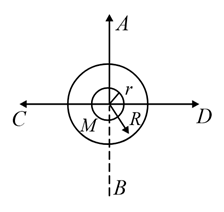
The figure shows two solid discs with radius $$R$$ and $$r$$ respectively. If mass per unit area is the same for both, what is the ratio of MI of bigger disc around axis $$AB$$ (Which is $$\perp$$ to the plane of the disc and passing through its centre) of MI of smaller disc around one of its diameters lying on its plane? Given $$M$$ is the mass of the larger disc.
```html
We need to find the ratio of the moment of inertia (MI) of a larger solid disc to that of a smaller solid disc based on the conditions given.
From the problem details, both solid discs have the same mass per unit area (surface mass density, $$\sigma$$):
$$\sigma = \frac{\text{Mass}}{\text{Area}}$$
$$M = \sigma \cdot (\pi R^2)$$
$$m = \sigma \cdot (\pi r^2)$$
Taking the ratio of their masses eliminates the constant density $$\sigma$$:
$$\frac{M}{m} = \frac{R^2}{r^2} \implies m = M\frac{r^2}{R^2}$$
$$I_1 = \frac{1}{2}MR^2$$
$$I_2 = \frac{1}{4}mr^2$$
Substitute the expression for the smaller mass $$m$$ into the equation for $$I_2$$:
$$I_2 = \frac{1}{4} \left( M\frac{r^2}{R^2} \right) r^2 = \frac{1}{4}M\frac{r^4}{R^2}$$
Now, write out the explicit ratio of $$I_1$$ to $$I_2$$:
$$\frac{I_1}{I_2} = \frac{\frac{1}{2}MR^2}{\frac{1}{4}M\frac{r^4}{R^2}}$$
Cancel out the mass variable $$M$$ and simplify the fractions:
$$\frac{I_1}{I_2} = \frac{4}{2} \cdot \frac{R^2}{\left(\frac{r^4}{R^2}\right)} = 2 \cdot \frac{R^4}{r^4}$$
Expressing this back as a clean ratio format:
$$I_1 : I_2 = 2R^4 : r^4$$
The ratio of the moments of inertia between the two discs is $$2R^4 : r^4$$, which corresponds exactly to the D option
.
```
Was this solution helpful?
Click on the Email ☝️ to Watch the Video Solution
Create a FREE account and get:
_1.webp)

Educational materials for JEE preparation

Ask our AI anything

AI can make mistakes. Please verify important information.
AI can make mistakes. Please verify important information.
