
Join Our JEE Preparation Group
Prep with like-minded aspirants; Get access to free daily tests and study material.
Sign in
Please select an account to continue using cracku.in
↓ →
Join Our JEE Preparation Group
Prep with like-minded aspirants; Get access to free daily tests and study material.
A light cylindrical vessel is kept on a horizontal surface. Area of the base is $$A$$. A hole of cross-sectional area $$a$$ is made just at its bottom side. The minimum coefficient of friction necessary to prevent sliding the vessel due to the impact force of the emerging liquid is
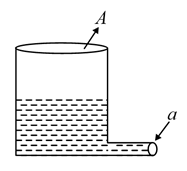
We need to determine the minimum coefficient of friction ($\mu$) required to keep a light cylindrical vessel stationary when liquid flows out of a small hole at its bottom.
From the problem , two main horizontal forces govern whether the cylinder will slide:
$$F_t = \rho a v^2$$
Where $$\rho$$ is the density of the liquid, and $$v$$ is the velocity of efflux. By Torricelli's Law, $$v^2 = 2gh$$ (where $$h$$ is the height of the liquid column). Substituting this gives:$$F_t = \rho a (2gh) = 2\rho g h a$$
$$f_s = \mu N$$
Since the cylindrical vessel itself is described as "light" (mass of the container is negligible), the normal force is solely due to the weight of the liquid inside it:$$N = \text{Mass of liquid} \times g = (\rho \cdot \text{Volume}) \cdot g = \rho (A h) g$$
Where $A$ is the base cross-sectional area of the vessel. Therefore, the maximum friction is:$$f_s = \mu \rho g h A$$
To prevent the vessel from sliding, the limiting friction force must be greater than or equal to the horizontal impact thrust force:
$$f_s \ge F_t$$
Substitute our derived expressions for both forces into the inequality:
$$\mu \rho g h A \ge 2\rho g h a$$
We can simplify the expression by canceling out the common terms ($\rho, g,$ and $h$) from both sides:
$$\mu A \ge 2a$$
Isolating the friction coefficient ($\mu$):
$$\mu \ge \frac{2a}{A}$$
The minimum coefficient of friction necessary to prevent the cylinder from moving is:
$$\mu = \frac{2a}{A}$$
This corresponds exactly to Option C.
Was this solution helpful?
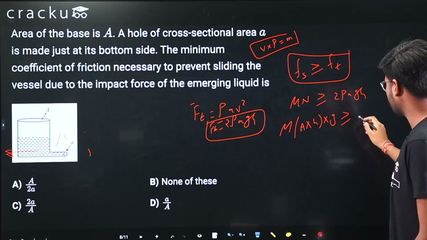
Click on the Email ☝️ to Watch the Video Solution
Create a FREE account and get:
_1.webp)

Educational materials for JEE preparation

Ask our AI anything

AI can make mistakes. Please verify important information.
AI can make mistakes. Please verify important information.
