
Join Our JEE Preparation Group
Prep with like-minded aspirants; Get access to free daily tests and study material.
Sign in
Please select an account to continue using cracku.in
↓ →
Join Our JEE Preparation Group
Prep with like-minded aspirants; Get access to free daily tests and study material.
List-I List-II
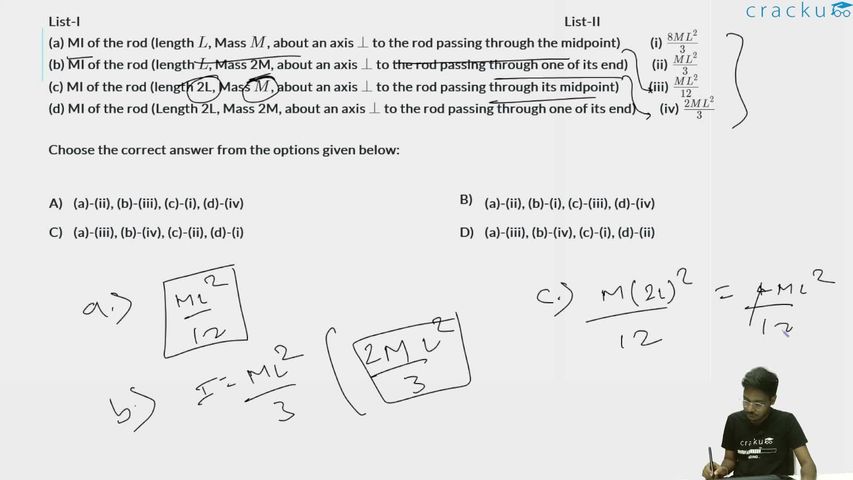
(a) MI of the rod (length $$L$$, Mass $$M$$, about an axis $$\perp$$ to the rod passing through the midpoint) (i) $$\frac{8ML^2}{3}$$
(b) MI of the rod (length $$L$$, Mass 2M, about an axis $$\perp$$ to the rod passing through one of its end) (ii) $$\frac{ML^2}{3}$$
(c) MI of the rod (length 2L, Mass $$M$$, about an axis $$\perp$$ to the rod passing through its midpoint) (iii) $$\frac{ML^2}{12}$$
(d) MI of the rod (Length 2L, Mass 2M, about an axis $$\perp$$ to the rod passing through one of its end) (iv) $$\frac{2ML^2}{3}$$
Choose the correct answer from the options given below:
We recall the standard formula for the moment of inertia of a uniform slender rod of length $$l$$ and mass $$m$$ about an axis perpendicular to the rod:
1. When the axis passes through the mid-point of the rod, the formula is
$$I_{\text{mid}}=\frac{1}{12}\,m\,l^{2}.$$
2. When the axis passes through one end of the rod, the formula is
$$I_{\text{end}}=\frac{1}{3}\,m\,l^{2}.$$
With these two relations ready, we now evaluate each item in List-I one by one and match with List-II.
Term (a): The rod has length $$L$$ and mass $$M$$. The axis is perpendicular to the rod and passes through its mid-point, so we use the mid-point formula.
$$I_{(a)} \;=\;\frac{1}{12}\,M\,L^{2}.$$
Checking List-II, we see that $$\frac{ML^{2}}{12}$$ is entry (iii). So, (a) corresponds to (iii).
Term (b): The rod has the same length $$L$$ but double the mass, i.e. $$2M$$. The axis is at one end, so we use the end-point formula.
First write the formula: $$I_{\text{end}}=\frac{1}{3}\,m\,l^{2}.$$ Now substitute $$m=2M$$ and $$l=L$$:
$$I_{(b)} \;=\;\frac{1}{3}\,(2M)\,L^{2} =\;\frac{2\,M\,L^{2}}{3}.$$
Looking at List-II, $$\dfrac{2ML^{2}}{3}$$ is entry (iv). Therefore, (b) matches (iv).
Term (c): The rod now has length $$2L$$ while the mass is $$M$$. The axis again passes through the mid-point, so we use the mid-point formula.
Formula: $$I_{\text{mid}}=\frac{1}{12}\,m\,l^{2}.$$ Substituting $$m=M$$ and $$l=2L$$ gives
$$I_{(c)} \;=\;\frac{1}{12}\,M\,(2L)^{2} =\;\frac{1}{12}\,M\,(4L^{2}) =\;\frac{4}{12}\,M\,L^{2} =\;\frac{1}{3}\,M\,L^{2}.$$
In List-II, $$\dfrac{ML^{2}}{3}$$ is entry (ii). Thus, (c) corresponds to (ii).
Term (d): The rod now has length $$2L$$ and mass $$2M$$, with the axis at one end. Hence we again use the end-point formula.
Formula: $$I_{\text{end}}=\frac{1}{3}\,m\,l^{2}.$$ Substituting $$m=2M$$ and $$l=2L$$ yields
$$I_{(d)} \;=\;\frac{1}{3}\,(2M)\,(2L)^{2} =\;\frac{2}{3}\,M\,(4L^{2}) =\;\frac{8}{3}\,M\,L^{2}.$$
The expression $$\dfrac{8ML^{2}}{3}$$ appears in List-II as entry (i). Consequently, (d) matches with (i).
Gathering all the matches we have obtained:
(a) → (iii), (b) → (iv), (c) → (ii), (d) → (i).
When we inspect the four options, we see that this exact sequence is given in Option C.
Hence, the correct answer is Option C.
Was this solution helpful?
Click on the Email ☝️ to Watch the Video Solution
Create a FREE account and get:
_1.webp)

Educational materials for JEE preparation

Ask our AI anything

AI can make mistakes. Please verify important information.
AI can make mistakes. Please verify important information.
