
Join Our JEE Preparation Group
Prep with like-minded aspirants; Get access to free daily tests and study material.
Sign in
Please select an account to continue using cracku.in
↓ →
Join Our JEE Preparation Group
Prep with like-minded aspirants; Get access to free daily tests and study material.
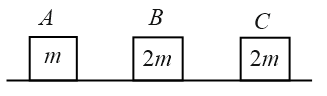
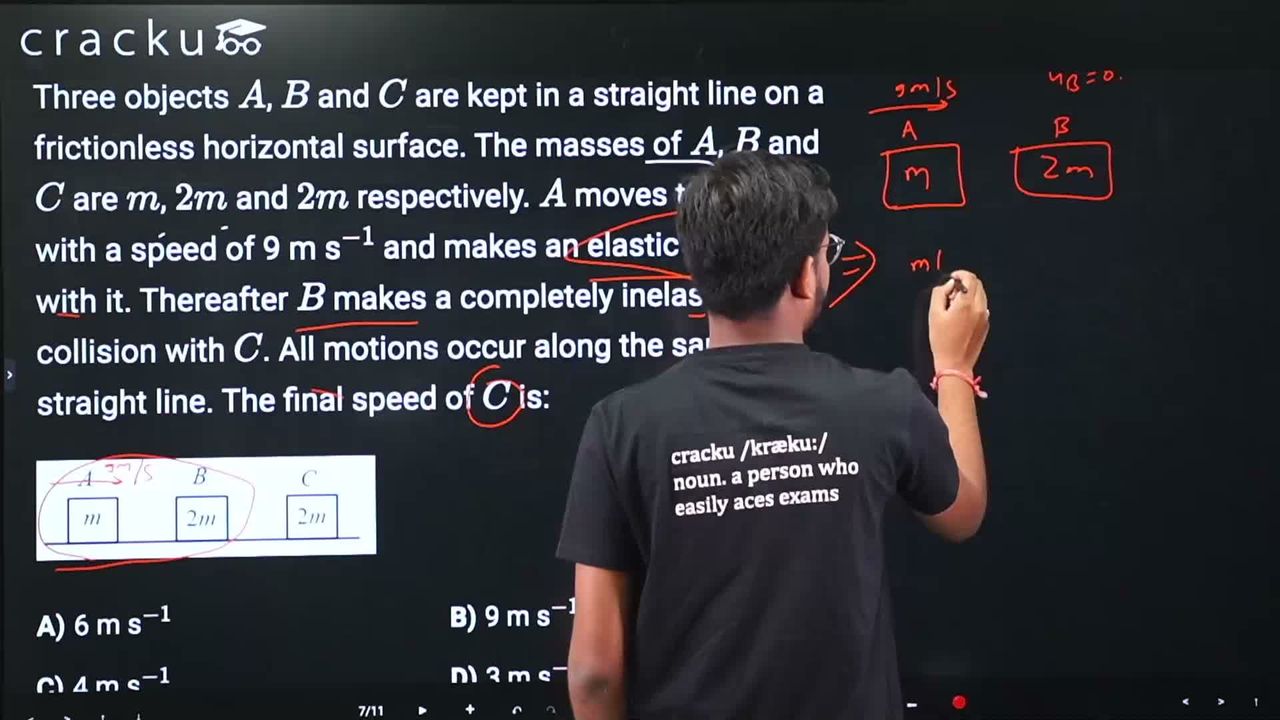
Three objects $$A$$, $$B$$ and $$C$$ are kept in a straight line on a frictionless horizontal surface. The masses of $$A$$, $$B$$ and $$C$$ are $$m$$, $$2m$$ and $$2m$$ respectively. $$A$$ moves towards $$B$$ with a speed of 9 m s$$^{-1}$$ and makes an elastic collision with it. Thereafter $$B$$ makes a completely inelastic collision with $$C$$. All motions occur along the same straight line. The final speed of $$C$$ is:
```html
We need to find the final speed of object $$C$$ after a series of two successive collisions on a frictionless horizontal surface.
From the problem statement page:
Since the collision between $$A$$ and $$B$$ is perfectly elastic ($$e = 1$$), we can find the final velocity of $$B$$ ($$v_B$$) immediately after this impact using the standard 1D elastic collision formula:
$$v_B = \frac{2m_A u_A}{m_A + m_B} + \frac{(m_B - m_A)u_B}{m_A + m_B}$$
Since $$u_B = 0$$, the second term drops out. Substituting the mass values:
$$v_B = \frac{2(m)(9)}{m + 2m} = \frac{18m}{3m} = 6\text{ m s}^{-1}$$
After the first collision, $$B$$ moves toward $$C$$ with a speed of $$6\text{ m s}^{-1}$$. When $$B$$ collides with $$C$$, they stick together because the collision is completely inelastic.
Applying the principle of conservation of linear momentum for this pair:
$$m_B v_B + m_C u_C = (m_B + m_C) v_f$$
Since $$C$$ was at rest ($$u_C = 0$$), the equation becomes:
$$(2m)(6) + 0 = (2m + 2m) v_f$$
$$12m = 4m \cdot v_f$$
Solving for the combined final velocity ($$v_f$$):
$$v_f = \frac{12m}{4m} = 3\text{ m s}^{-1}$$
The final speed of object $$C$$ is 3 $$\text{m s}^{-1}$$.
Was this solution helpful?
Click on the Email ☝️ to Watch the Video Solution
Create a FREE account and get:
_1.webp)

Educational materials for JEE preparation

Ask our AI anything

AI can make mistakes. Please verify important information.
AI can make mistakes. Please verify important information.
