
Join Our JEE Preparation Group
Prep with like-minded aspirants; Get access to free daily tests and study material.
Sign in
Please select an account to continue using cracku.in
↓ →
Join Our JEE Preparation Group
Prep with like-minded aspirants; Get access to free daily tests and study material.
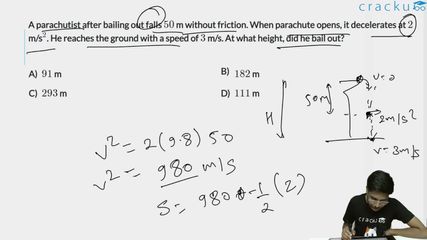
A parachutist after bailing out falls $$50$$ m without friction. When parachute opens, it decelerates at $$2$$ m/s$$^2$$. He reaches the ground with a speed of $$3$$ m/s. At what height, did he bail out?
The parachutist bails out from rest, meaning his initial velocity ($$u_1$$) is zero:
$$u_1 = 0 \,\, \text{m/s}$$
He falls a distance of $$h_1 = 50 \,\, \text{m}$$ under gravity without any air friction. Taking downward as the positive direction, his acceleration during this phase is $$a_1 = g = 9.8 \,\, \text{m/s}^2$$. We find his velocity ($$v_1$$) just as the parachute opens using the third equation of motion ($$v^2 = u^2 + 2as$$):
$$v_1^2 = u_1^2 + 2 \cdot g \cdot h_1$$
$$v_1^2 = 0^2 + 2 \cdot 9.8 \cdot 50$$
$$v_1^2 = 980 \,\, \text{m}^2/\text{s}^2$$
When the parachute opens, the system begins to slow down. Let us define the kinematic parameters for this second phase of motion:
Applying the third equation of motion for this deceleration phase:
$$v_2^2 = u_2^2 + 2 \cdot a_2 \cdot h_2$$
$$(3)^2 = 980 + 2 \cdot (-2) \cdot h_2$$
$$9 = 980 - 4 \cdot h_2$$
Rearranging the equation to isolate the second height segment ($$h_2$$):
$$4 \cdot h_2 = 980 - 9$$
$$4 \cdot h_2 = 971$$
$$h_2 = \frac{971}{4} = 242.75 \,\, \text{m}$$
The total height ($$H$$) from which the parachutist initially bailed out is the sum of the distance covered during the free fall ($$h_1$$) and the distance covered while decelerating ($$h_2$$):
$$H = h_1 + h_2$$
$$H = 50 + 242.75 = 292.75 \,\, \text{m}$$
Rounding this value to the nearest whole integer gives:
$$H \approx 293 \,\, \text{m}$$
Concept Check: The problem breaks into two distinct acceleration zones. During the initial brief gravity drop ($$50 \,\, \text{m}$$), the jumper builds a massive velocity of nearly $$31.3 \,\, \text{m/s}$$. Because the parachute’s braking force is relatively gentle ($$2 \,\, \text{m/s}^2$$), a long braking runway of over $$242 \,\, \text{m}$$ is required to safely bleed off that velocity down to a walking speed of $$3 \,\, \text{m/s}$$.
Correct Option Key: Option C ($$293 \,\, \text{m}$$)
Was this solution helpful?
Click on the Email ☝️ to Watch the Video Solution
Create a FREE account and get:
_1.webp)

Educational materials for JEE preparation

Ask our AI anything

AI can make mistakes. Please verify important information.
AI can make mistakes. Please verify important information.
