
Join Our JEE Preparation Group
Prep with like-minded aspirants; Get access to free daily tests and study material.
Sign in
Please select an account to continue using cracku.in
↓ →
Join Our JEE Preparation Group
Prep with like-minded aspirants; Get access to free daily tests and study material.
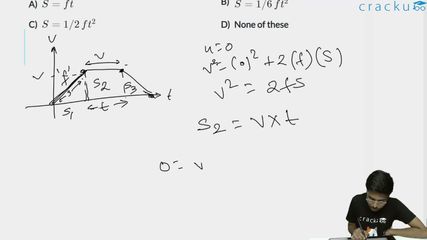
A car starting from rest accelerates at the rate $$f$$ through a distance $$S$$, then continues at constant speed for time $$t$$ and then decelerates at the rate $$f/2$$ to come to rest. If the total distance traversed is $$15S$$, then
The car starts from rest, meaning its initial velocity ($$u_1$$) is zero:
$$u_1 = 0$$
It accelerates at a uniform rate $$f$$ over a distance $$S$$. Let its final velocity at the end of this phase be $$v$$. Using the third equation of motion ($$v^2 = u^2 + 2as$$):
$$v^2 = 0^2 + 2 \cdot f \cdot S$$
$$v^2 = 2 \cdot f \cdot S \quad \text{--- (Eq. 1)}$$
The car continues to travel at this constant maximum speed $$v$$ for a time duration $$t$$. Let the distance covered during this phase be $$S_2$$:
$$S_2 = v \cdot t \quad \text{--- (Eq. 2)}$$
The car then decelerates at a uniform rate of $$\frac{f}{2}$$ to come completely to rest. Let us define the parameters for this final phase:
Applying the third equation of motion again:
$$0^2 = v^2 + 2 \cdot \left(-\frac{f}{2}\right) \cdot S_3$$
$$0 = v^2 - f \cdot S_3$$
$$S_3 = \frac{v^2}{f}$$
Substituting the value of $$v^2 = 2 \cdot f \cdot S$$ from Equation 1 into this expression gives:
$$S_3 = \frac{2 \cdot f \cdot S}{f} = 2S$$
The total distance traversed by the car during all three phases of its journey combined is given as $$15S$$:
$$S_{\text{total}} = S + S_2 + S_3 = 15S$$
Substitute our known values for $$S_3 = 2S$$ into this relation:
$$S + S_2 + 2S = 15S$$
$$3S + S_2 = 15S$$
$$S_2 = 12S$$
Substitute the expression for $$S_2$$ from Equation 2 ($$S_2 = v \cdot t$$) into our new relation:
$$v \cdot t = 12S$$
Square both sides of the equation to easily substitute our initial $$v^2$$ term:
$$v^2 \cdot t^2 = 144 \cdot S^2$$
Substitute $$v^2 = 2 \cdot f \cdot S$$ from Equation 1:
$$(2 \cdot f \cdot S) \cdot t^2 = 144 \cdot S^2$$
Divide both sides by $$2S$$ (since distance $$S \neq 0$$):
$$f \cdot t^2 = 72 \cdot S$$
Isolating the value of distance $$S$$ yields:
$$S = \frac{1}{72} \cdot f \cdot t^2$$
Concept Check: Because this specific mathematical relation is missing from options A, B, and C, the correct choice is "None of these".
Correct Option Key: None of these
Was this solution helpful?
Click on the Email ☝️ to Watch the Video Solution
Create a FREE account and get:
_1.webp)

Educational materials for JEE preparation

Ask our AI anything

AI can make mistakes. Please verify important information.
AI can make mistakes. Please verify important information.
