
Join Our JEE Preparation Group
Prep with like-minded aspirants; Get access to free daily tests and study material.
Sign in
Please select an account to continue using cracku.in
↓ →
Join Our JEE Preparation Group
Prep with like-minded aspirants; Get access to free daily tests and study material.
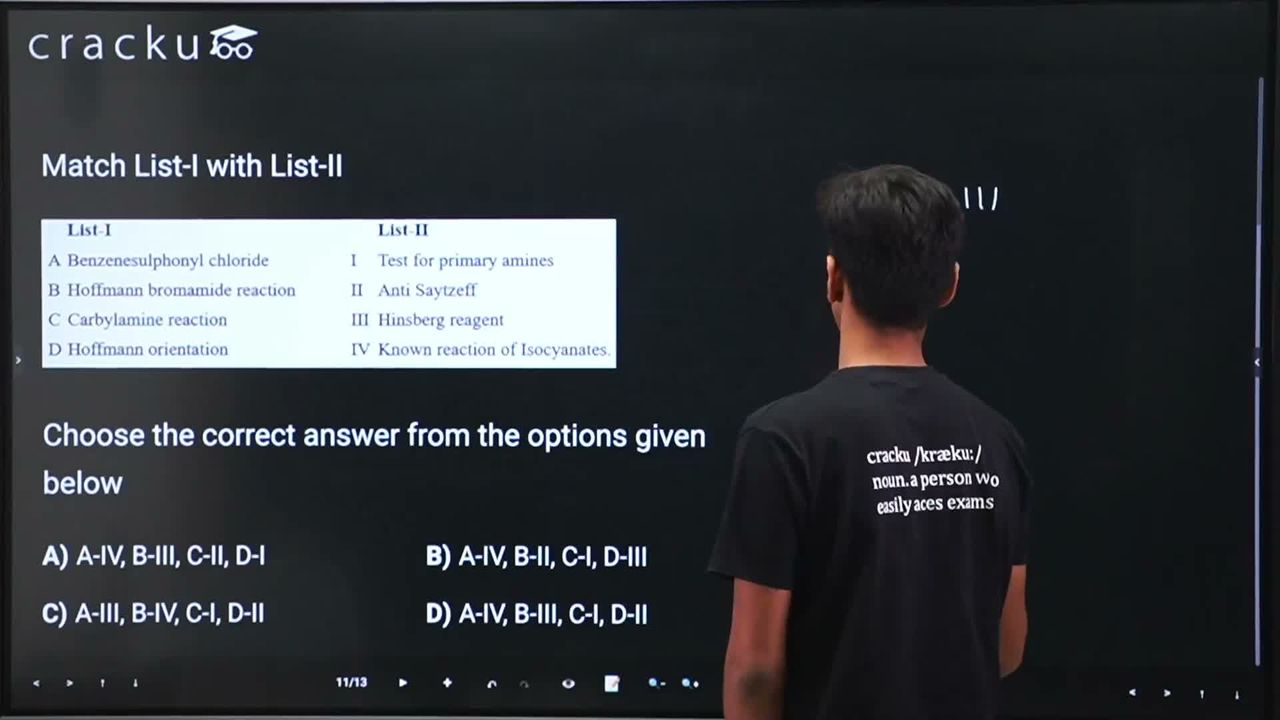
Match List-I with List-II
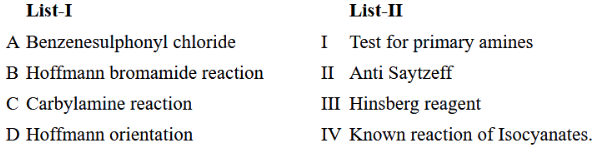
Choose the correct answer from the options given below
We need to match List-I (chemical reactions/reagents) with List-II (their descriptions). To do this, each item is examined in turn.
(A) Benzenesulphonyl chloride: Benzenesulphonyl chloride ($$C_6H_5SO_2Cl$$) is known as the Hinsberg reagent. It is used in the Hinsberg test to distinguish between primary, secondary, and tertiary amines, so A matches with (III) Hinsberg reagent.
(B) Hoffmann bromamide reaction: In the Hoffmann bromamide degradation, a primary amide is treated with $$Br_2$$ and NaOH to form an amine with one fewer carbon atom. The intermediate in this reaction is an isocyanate (R-N=C=O), and thus B matches with (IV) Known reaction of Isocyanates.
(C) Carbylamine reaction: The carbylamine reaction (also called isocyanide test) involves heating a primary amine with chloroform and alcoholic KOH to form an isocyanide with a foul smell. Being a test for primary amines, C matches with (I) Test for primary amines.
(D) Hoffmann orientation: Hoffmann elimination (or Hoffmann orientation) gives the less substituted alkene as the major product when a quaternary ammonium salt undergoes elimination. This is opposite to Saytzeff’s rule, hence it is called Anti-Saytzeff elimination, and D matches with (II) Anti Saytzeff.
Accordingly, the final matching is A-III, B-IV, C-I, D-II, and the correct answer is Option C: A-III, B-IV, C-I, D-II.
Was this solution helpful?
Click on the Email ☝️ to Watch the Video Solution
Create a FREE account and get:
_1.webp)

Educational materials for JEE preparation

Ask our AI anything

AI can make mistakes. Please verify important information.
AI can make mistakes. Please verify important information.
