Join Our JEE Preparation Group
Prep with like-minded aspirants; Get access to free daily tests and study material.
Sign in
Please select an account to continue using cracku.in
↓ →
Join Our JEE Preparation Group
Prep with like-minded aspirants; Get access to free daily tests and study material.
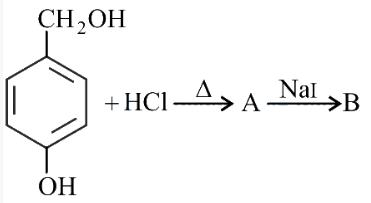
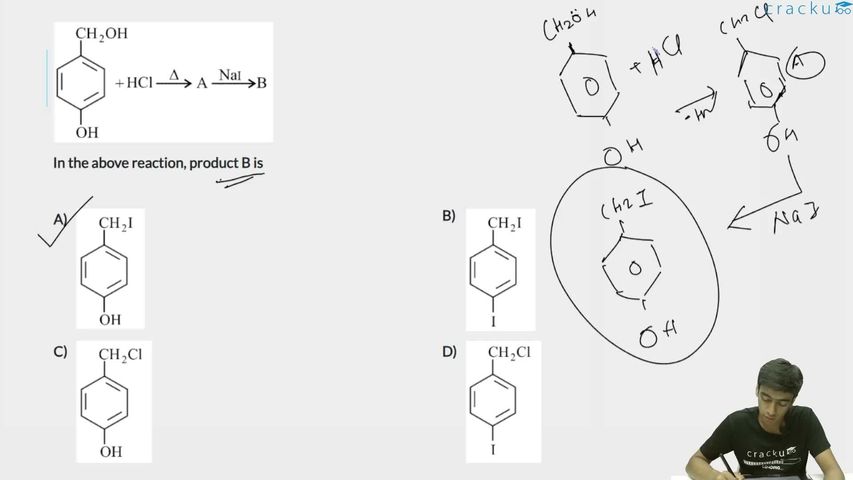
The starting reactant is 4-(hydroxymethyl)phenol. It features a benzene ring with two distinct hydroxyl (-OH) environments:
When treated with HCl and heat (Δ):
Therefore, Product A is 4-(chloromethyl)phenol, where the top substituent is now a -CH₂Cl group.
When Product A reacts with NaI (Sodium Iodide):
Consequently, the -CH₂Cl group is converted directly into a -CH₂I group.
Was this solution helpful?
Click on the Email ☝️ to Watch the Video Solution
Create a FREE account and get:
_1.webp)

Educational materials for JEE preparation

Ask our AI anything

AI can make mistakes. Please verify important information.
AI can make mistakes. Please verify important information.