
Join Our JEE Preparation Group
Prep with like-minded aspirants; Get access to free daily tests and study material.
Sign in
Please select an account to continue using cracku.in
↓ →
Join Our JEE Preparation Group
Prep with like-minded aspirants; Get access to free daily tests and study material.
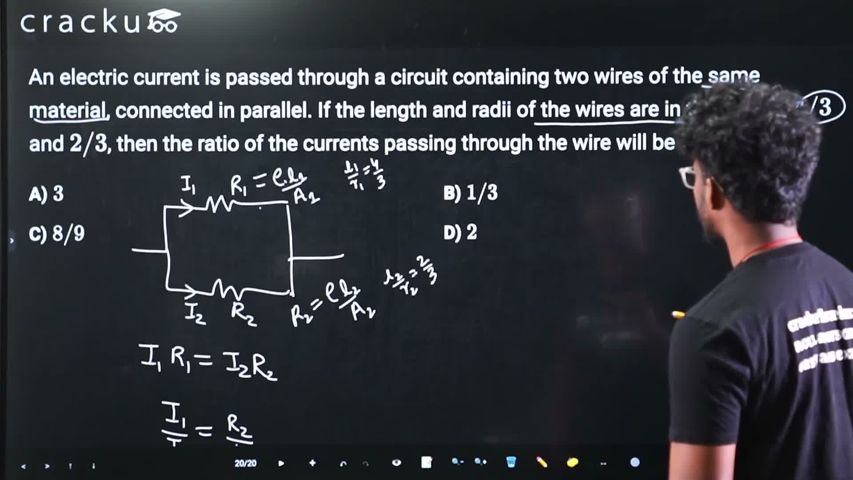
An electric current is passed through a circuit containing two wires of the same material, connected in parallel. If the length and radii of the wires are in the ratio of $$4/3$$ and $$2/3$$, then the ratio of the currents passing through the wire will be
Let the lengths of the two wires be $$L_1$$ and $$L_2$$, and their radii be $$r_1$$ and $$r_2$$.
From the given information, we have the ratio of their lengths:
$$ \frac{L_1}{L_2} = \frac{4}{3} \implies \frac{L_2}{L_1} = \frac{3}{4} $$
And the ratio of their radii:
$$ \frac{r_1}{r_2} = \frac{2}{3} $$
Since both wires are made of the same material, their resistivity ($$\rho$$) is the same. The resistance ($$R$$) of a wire is given by the formula:
$$ R = \rho \frac{L}{A} = \rho \frac{L}{\pi r^2} $$
Because the two wires are connected in parallel, the potential difference ($$V$$) across both wires is identical. According to Ohm's Law ($$V = IR$$), the current passing through a wire is inversely proportional to its resistance when the voltage is constant:
$$ I = \frac{V}{R} \implies I \propto \frac{1}{R} $$
Therefore, the ratio of the currents passing through the two wires is:
$$ \frac{I_1}{I_2} = \frac{R_2}{R_1} $$
Substituting the formula for resistance into this ratio:
$$ \frac{I_1}{I_2} = \frac{ \rho \frac{L_2}{\pi r_2^2} }{ \rho \frac{L_1}{\pi r_1^2} } $$
Simplifying the expression by canceling the common terms ($$\rho$$ and $$\pi$$):
$$ \frac{I_1}{I_2} = \left( \frac{L_2}{L_1} \right) \times \left( \frac{r_1}{r_2} \right)^2 $$
Now, substitute the given numerical ratios into the simplified equation:
$$ \frac{I_1}{I_2} = \left( \frac{3}{4} \right) \times \left( \frac{2}{3} \right)^2 $$
$$ \frac{I_1}{I_2} = \frac{3}{4} \times \frac{4}{9} $$
$$ \frac{I_1}{I_2} = \frac{3}{9} $$
$$ \frac{I_1}{I_2} = \frac{1}{3} $$
Was this solution helpful?
Click on the Email ☝️ to Watch the Video Solution
Create a FREE account and get:
_1.webp)

Educational materials for JEE preparation

Ask our AI anything

AI can make mistakes. Please verify important information.
AI can make mistakes. Please verify important information.
