
Join Our JEE Preparation Group
Prep with like-minded aspirants; Get access to free daily tests and study material.
Sign in
Please select an account to continue using cracku.in
↓ →
Join Our JEE Preparation Group
Prep with like-minded aspirants; Get access to free daily tests and study material.
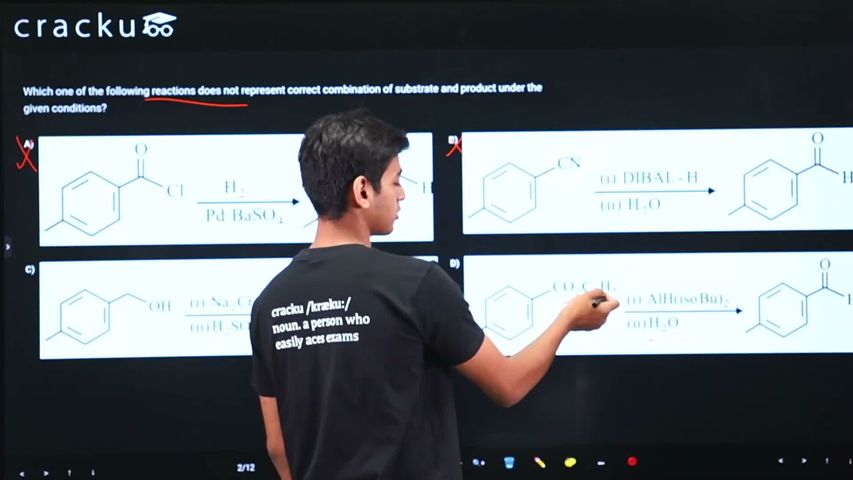
Which one of the following reactions does not represent correct combination of substrate and product under the given conditions?
Option $$\mathrm{C}$$ is incorrect.
In reaction $$\mathrm{(C)}$$, the starting compound is a primary alcohol.
Treatment with $$\mathrm{Na_2Cr_2O_7/H_2SO_4}$$ forms a strong oxidising medium.
Primary alcohols under these conditions are completely oxidised into carboxylic acids.
Hence, the actual product formed is:
$$\mathrm{p\text{-}Toluic\ Acid}$$
and not $$\mathrm{p\text{-}Tolualdehyde}$$.
Reaction $$\mathrm{(A)}$$ is the $$\mathrm{Rosenmund\ Reduction}$$, where $$\mathrm{H_2/Pd-BaSO_4}$$ selectively reduces an acid chloride into an aldehyde.
Reaction $$\mathrm{(B)}$$ uses $$\mathrm{DIBAL\text{-}H}$$, which reduces a nitrile into an aldehyde after hydrolysis.
Reaction $$\mathrm{(D)}$$ also uses $$\mathrm{DIBAL\text{-}H}$$, which selectively reduces an ester into an aldehyde.
Therefore, the incorrect reaction is:
$$\mathrm{C}$$
Was this solution helpful?
Click on the Email ☝️ to Watch the Video Solution
Create a FREE account and get:
_1.webp)

Educational materials for JEE preparation

Ask our AI anything

AI can make mistakes. Please verify important information.
AI can make mistakes. Please verify important information.
