
Join Our JEE Preparation Group
Prep with like-minded aspirants; Get access to free daily tests and study material.
Sign in
Please select an account to continue using cracku.in
↓ →
Join Our JEE Preparation Group
Prep with like-minded aspirants; Get access to free daily tests and study material.
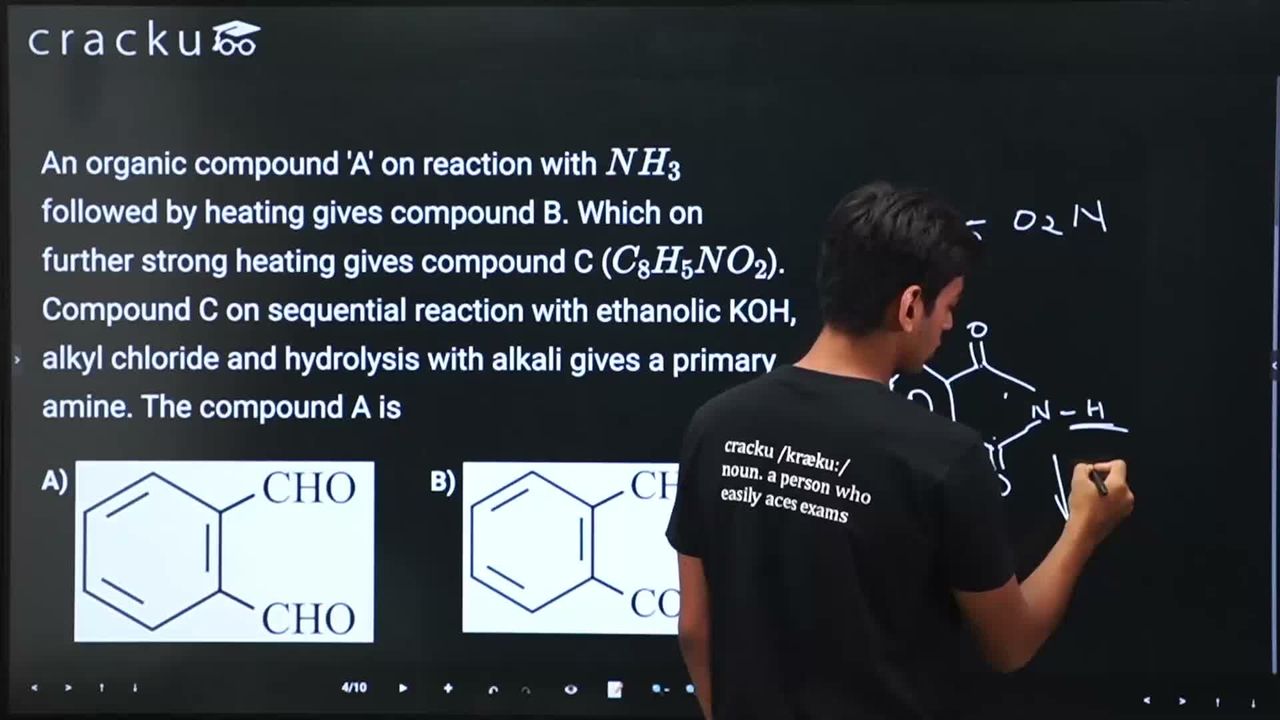
An organic compound 'A' on reaction with $$NH_3$$ followed by heating gives compound B. Which on further strong heating gives compound C ($$C_8H_5NO_2$$). Compound C on sequential reaction with ethanolic KOH, alkyl chloride and hydrolysis with alkali gives a primary amine. The compound A is
The reaction sequence described is characteristic of the Gabriel Phthalimide Synthesis used for preparing primary amines.
In this synthesis, the key intermediate is phthalimide.
Compound $$C$$ has the molecular formula:
$$C_8H_5NO_2$$
which corresponds to phthalimide.
Phthalimide reacts with ethanolic $$KOH$$ to form potassium phthalimide, which then reacts with an alkyl halide $$R-Cl$$.
Subsequent alkaline hydrolysis yields a primary amine.
Therefore, Compound $$C$$ must be phthalimide.
Phthalimide is prepared from phthalic acid through the following sequence.
Phthalic acid reacts with ammonia to form ammonium phthalate.
On heating, ammonium phthalate loses water to form phthalamide.
Further heating causes cyclization and loss of ammonia to produce phthalimide.
Thus, Compound $$A$$ is phthalic acid.
Was this solution helpful?
Click on the Email ☝️ to Watch the Video Solution
Create a FREE account and get:
_1.webp)

Educational materials for JEE preparation

Ask our AI anything

AI can make mistakes. Please verify important information.
AI can make mistakes. Please verify important information.
