
Join Our JEE Preparation Group
Prep with like-minded aspirants; Get access to free daily tests and study material.
Sign in
Please select an account to continue using cracku.in
↓ →
Join Our JEE Preparation Group
Prep with like-minded aspirants; Get access to free daily tests and study material.
In the below mentioned compounds the decreasing order of reactivity towards electrophilic substitution is
(i)
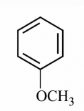
(ii)
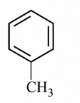
(iii)
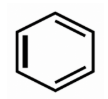
(iv)
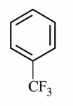
The four compounds are assumed to be the common monosubstituted benzenes used in standard JEE problems:
(i) Aniline $$C_6H_5NH_2$$
(ii) Phenol $$C_6H_5OH$$
(iii) Toluene $$C_6H_5CH_3$$
(iv) Nitrobenzene $$C_6H_5NO_2$$
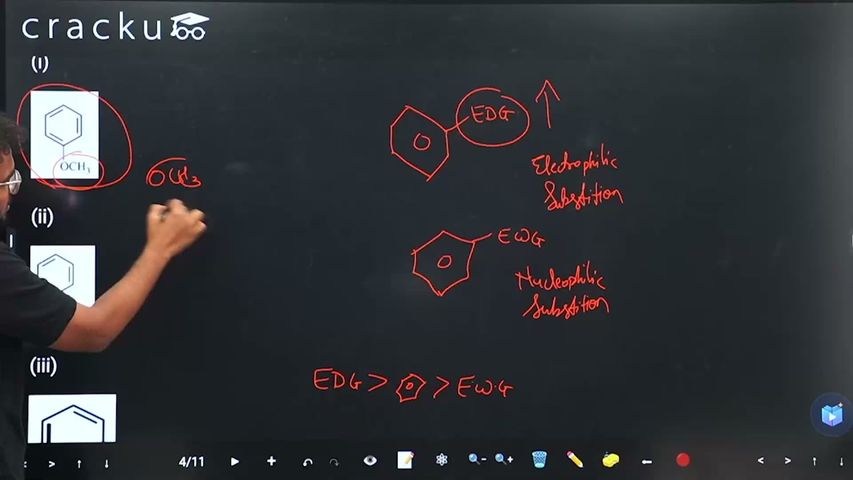
In electrophilic aromatic substitution (EAS) the rate depends on how strongly the substituent donates or withdraws electrons from the ring.
Guiding principles:
1. An electron-donating group (EDG) increases electron density and therefore activates the ring.
2. An electron-withdrawing group (EWG) decreases electron density and therefore deactivates the ring.
3. The order of activation depends on the magnitude of the +M (mesomeric), +I (inductive) or +H (hyperconjugative) effects shown below.
Substituent analysis
(i) $$-NH_2$$ : Strong +M (lone pair conjugation) and weak +I → very strong activator.
(ii) $$-OH$$ : Strong +M (lone-pair donation) but a −I effect; overall donation slightly weaker than $$-NH_2$$ → strong activator.
(iii) $$-CH_3$$ : No +M, only +H hyperconjugation and a feeble +I → weak activator.
(iv) $$-NO_2$$ : Strong −M (draws π electrons into the nitro group) and strong −I → strong deactivator.
Resultant reactivity order
Highest activation gives the fastest EAS; strongest deactivation gives the slowest. Therefore
$$C_6H_5NH_2 \; \gt \; C_6H_5OH \; \gt \; C_6H_5CH_3 \; \gt \; C_6H_5NO_2$$
Translating this back to the given numbering, the decreasing order of reactivity is
$$(i) \; \gt \; (ii) \; \gt \; (iii) \; \gt \; (iv).$$
Hence, the correct option is
Option D which is: (i) > (ii) > (iii) > (iv).
Was this solution helpful?
Click on the Email ☝️ to Watch the Video Solution
Create a FREE account and get:
_1.webp)

Educational materials for JEE preparation

Ask our AI anything

AI can make mistakes. Please verify important information.
AI can make mistakes. Please verify important information.
