
Join Our JEE Preparation Group
Prep with like-minded aspirants; Get access to free daily tests and study material.
Sign in
Please select an account to continue using cracku.in
↓ →
Join Our JEE Preparation Group
Prep with like-minded aspirants; Get access to free daily tests and study material.
A metal $$M$$ on heating in nitrogen gas gives $$Y$$. $$Y$$ on treatment with $$\text{H}_2\text{O}$$ gives a colourless gas which when passed through $$\text{CuSO}_4$$ solution gives a blue colour. $$Y$$ is
When a metal is heated in a current of nitrogen it generally forms the corresponding metal nitride. Thus
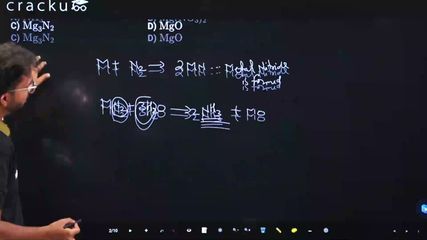
$$M + \dfrac{n}{2}\,N_2 \;\xrightarrow{\;\Delta\;}\; M\text{N}_n$$
The product $$Y$$ therefore should be a nitride of the given metal.
Nitrides react with water (or moist air) giving ammonia gas:
$$\text{Metal nitride} + 3\,H_2O \;\longrightarrow\; \text{Metal hydroxide} + NH_3$$
Ammonia, $$NH_3$$, is a colourless gas. When passed through an aqueous $$CuSO_4$$ solution it forms the deep-blue tetrammine complex $$[Cu(NH_3)_4]^{2+}$$, turning the solution blue: $$Cu^{2+} + 4\,NH_3 \rightarrow [Cu(NH_3)_4]^{2+}$$.
Hence the unknown solid $$Y$$ must be a metal nitride that furnishes $$NH_3$$ on hydrolysis.
Examining the options:
A. $$NH_3$$ - already a gas, not formed by heating a metal in $$N_2$$.
B. $$Mg(NO_3)_2$$ - a nitrate, gives $$NO_2$$/$$O_2$$ upon heating, not $$NH_3$$ on hydrolysis.
C. $$Mg_3N_2$$ - magnesium nitride; reacts with water to give $$NH_3$$:
$$Mg_3N_2 + 6\,H_2O \rightarrow 3\,Mg(OH)_2 + 2\,NH_3$$
The liberated $$NH_3$$ produces the observed blue colour with $$CuSO_4$$.
D. $$MgO$$ - oxide, gives no gas on treatment with water.
Only Option C satisfies all the observations.
Therefore, $$Y = Mg_3N_2$$.
Option C which is: $$\textbf{Mg}_3\textbf{N}_2$$
Was this solution helpful?
Click on the Email ☝️ to Watch the Video Solution
Create a FREE account and get:
_1.webp)

Educational materials for JEE preparation

Ask our AI anything

AI can make mistakes. Please verify important information.
AI can make mistakes. Please verify important information.
