Join Our JEE Preparation Group
Prep with like-minded aspirants; Get access to free daily tests and study material.
Sign in
Please select an account to continue using cracku.in
↓ →
Join Our JEE Preparation Group
Prep with like-minded aspirants; Get access to free daily tests and study material.
For a compound to be antiaromatic, it must be cyclic, planar, completely conjugated, and contain $$4n$$ $$\pi$$ electrons.
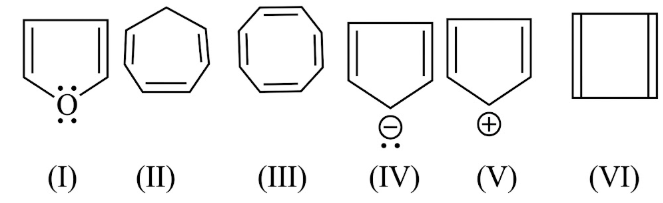
In furan, one lone pair of oxygen participates in conjugation. Thus, the ring contains $$6\pi$$ electrons and satisfies Hückel's $$4n+2$$ rule. Hence, furan is aromatic.
Cycloheptatriene contains an $$sp^3$$ hybridized carbon atom, which interrupts conjugation. Therefore, it is non-aromatic.
Cyclooctatetraene contains $$8\pi$$ electrons, but it adopts a non-planar tub-shaped structure to avoid antiaromaticity. Hence, it is non-aromatic.
In the cyclopentadienyl anion, the lone pair on the negatively charged carbon participates in conjugation, giving a total of $$6\pi$$ electrons. Therefore, it is aromatic.
The cyclopentadienyl cation contains $$4\pi$$ electrons and is cyclic, planar, and fully conjugated. Hence, it is antiaromatic.
Cyclobutadiene is cyclic, planar, fully conjugated, and contains $$4\pi$$ electrons. Hence, it is antiaromatic.
Therefore, the antiaromatic compounds are (V) and (VI) only.
Was this solution helpful?
Click on the Email ☝️ to Watch the Video Solution
Create a FREE account and get:
_1.webp)

Educational materials for JEE preparation

Ask our AI anything

AI can make mistakes. Please verify important information.
AI can make mistakes. Please verify important information.