
Join Our JEE Preparation Group
Prep with like-minded aspirants; Get access to free daily tests and study material.
Sign in
Please select an account to continue using cracku.in
↓ →
Join Our JEE Preparation Group
Prep with like-minded aspirants; Get access to free daily tests and study material.
Given below are two statements.
Statement I: In CuSO$$_4$$ · 5H$$_2$$O, Cu - O bonds are present.
Statement II: In CuSO$$_4$$ · 5H$$_2$$O, ligands coordinating with Cu (II) ion are O-and S-based ligands.
In the light of the above statements, choose the correct answer from the options given below
We need to evaluate the two statements about CuSO₄·5H₂O.
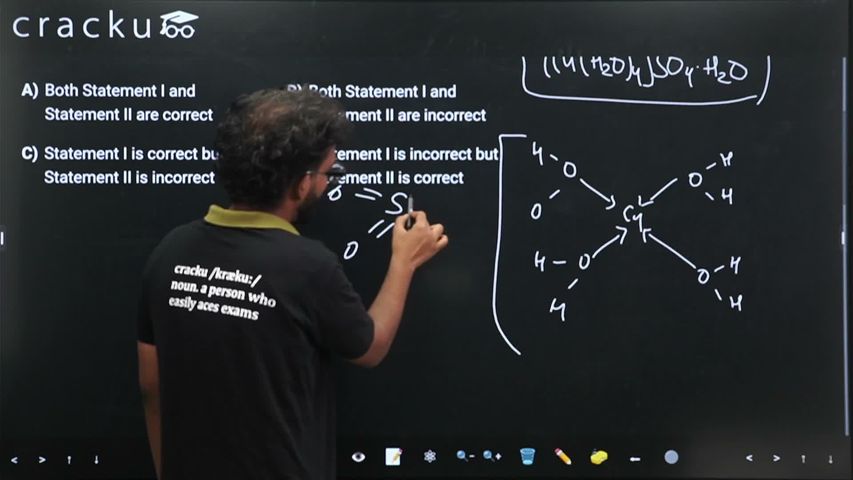
In the crystal structure of CuSO₄·5H₂O (blue vitriol), the Cu²⁺ ion is surrounded by 6 ligands in an octahedral arrangement: 4 water molecules in the equatorial plane (coordinated through their oxygen atoms) and 2 oxygen atoms from two different SO₄²⁻ ions in the axial positions. The 5th water molecule is not directly coordinated to Cu²⁺ but is held in the crystal lattice by hydrogen bonds between the coordinated water molecules and sulphate ions. The structure can be represented as: $$[Cu(H₂O)₄]SO₄·H₂O$$ where the sulphate oxygen atoms also coordinate to Cu²⁺.
Statement I says "In CuSO₄·5H₂O, Cu-O bonds are present." Cu²⁺ forms bonds with the oxygen atoms of the water molecules and the oxygen atoms of sulphate ions, so Cu-O bonds are indeed present. Therefore, Statement I is correct.
Statement II says "In CuSO₄·5H₂O, ligands coordinating with Cu(II) ion are O-and S-based ligands." The ligands coordinating with Cu²⁺ are water molecules (H₂O) — these coordinate through oxygen atoms (O-based ligands) — and sulphate ions (SO₄²⁻) — these also coordinate through oxygen atoms, not through sulphur atoms. All the ligands coordinate through oxygen atoms only; there are no S-based ligands since sulphur does not directly bond to Cu²⁺. Thus, Statement II is incorrect.
Statement I is correct but Statement II is incorrect. The answer is Option C: Statement I is correct but Statement II is incorrect.
Was this solution helpful?
Click on the Email ☝️ to Watch the Video Solution
Create a FREE account and get:
_1.webp)

Educational materials for JEE preparation

Ask our AI anything

AI can make mistakes. Please verify important information.
AI can make mistakes. Please verify important information.
