
Join Our JEE Preparation Group
Prep with like-minded aspirants; Get access to free daily tests and study material.
Sign in
Please select an account to continue using cracku.in
↓ →
Join Our JEE Preparation Group
Prep with like-minded aspirants; Get access to free daily tests and study material.
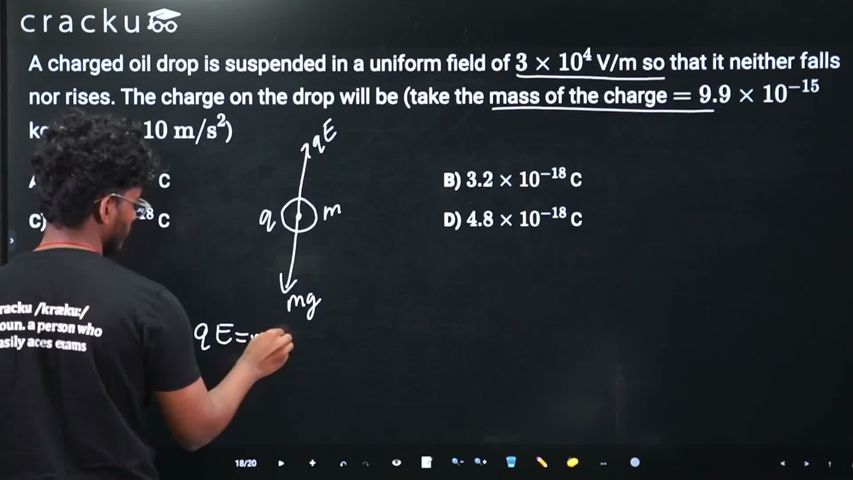
A charged oil drop is suspended in a uniform field of $$3 \times 10^4$$ V/m so that it neither falls nor rises. The charge on the drop will be (take the mass of the charge $$= 9.9 \times 10^{-15}$$ kg and $$g = 10 \text{ m/s}^2$$)
For the oil drop to remain suspended (neither falling nor rising), the net force acting on it must be zero. This means the upward electric force must perfectly balance the downward gravitational force.
The condition for equilibrium is:
$$F_e = F_g$$
Where:
$$F_e$$ is the electric force, given by $$F_e = qE$$
$$F_g$$ is the gravitational force (weight), given by $$F_g = mg$$
Equating the two forces:
$$qE = mg$$
Rearranging the formula to solve for the charge $$q$$:
$$q = \frac{mg}{E}$$
Given values:
$$m = 9.9 \times 10^{-15}\text{ kg}$$
Acceleration due to gravity, $$g = 10\text{ m/s}^2$$
Electric field, $$E = 3 \times 10^4\text{ V/m}$$
Substitute the given values into the equation:
$$q = \frac{(9.9 \times 10^{-15}) \times 10}{3 \times 10^4}$$
$$q = \frac{99 \times 10^{-15}}{3 \times 10^4}$$
$$q = 33 \times 10^{-19}\text{ C}$$
Expressing the final answer in standard scientific notation:
$$q = 3.3 \times 10^{-18}\text{ C}$$
Was this solution helpful?
Click on the Email ☝️ to Watch the Video Solution
Create a FREE account and get:
_1.webp)

Educational materials for JEE preparation

Ask our AI anything

AI can make mistakes. Please verify important information.
AI can make mistakes. Please verify important information.
