
Join Our JEE Preparation Group
Prep with like-minded aspirants; Get access to free daily tests and study material.
Sign in
Please select an account to continue using cracku.in
↓ →
Join Our JEE Preparation Group
Prep with like-minded aspirants; Get access to free daily tests and study material.
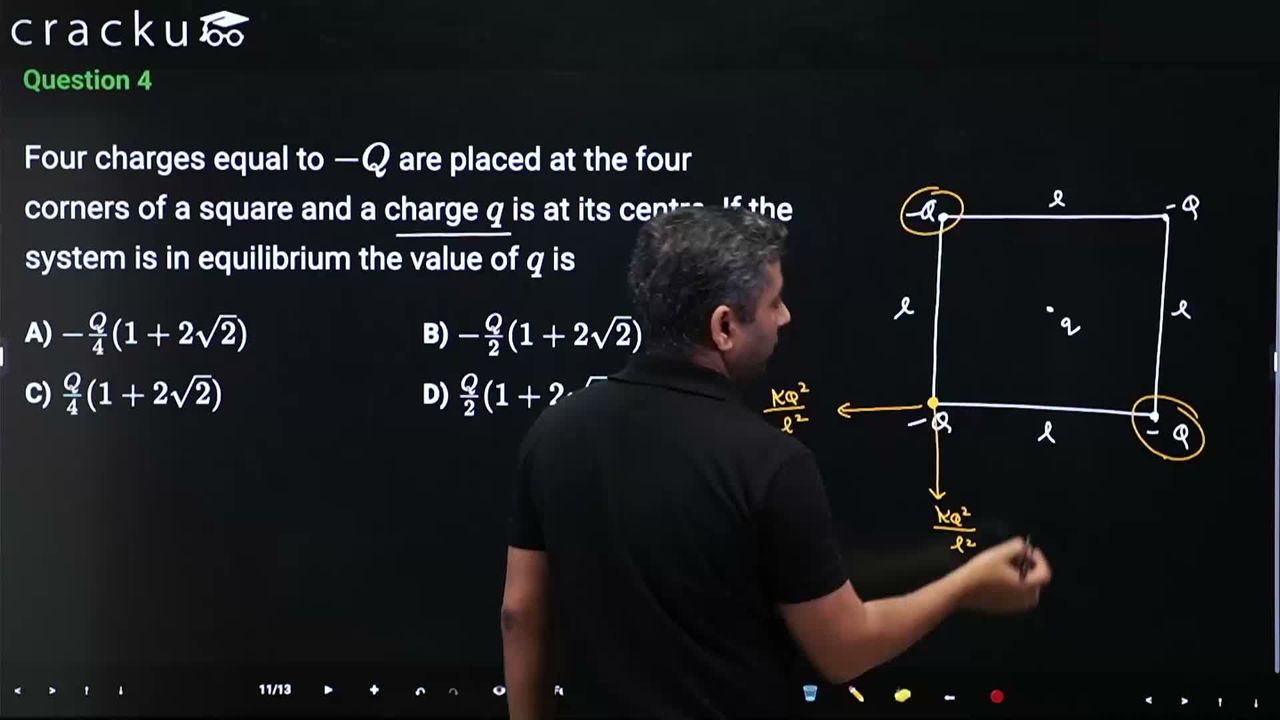
Four charges equal to $$-Q$$ are placed at the four corners of a square and a charge $$q$$ is at its centre. If the system is in equilibrium the value of $$q$$ is
Let the side length of the square be $$a$$.
The charges $$-Q$$ are placed at the four corners of the square, and a charge $$q$$ is placed at the center.
The distance from any corner to the center of the square is $$\frac{a}{\sqrt{2}}$$.
For the entire system to be in equilibrium, the net force on every single charge must be zero.
By symmetry, the charge $$q$$ at the center is already in equilibrium because the forces from the four corner charges cancel each other out.
Therefore, we must find the condition for the corner charges to be in equilibrium. Let's calculate the net force acting on one of the corner charges $$-Q$$.
There are three repulsive forces from the other three $$-Q$$ charges and one force from the center charge $$q$$.
{Step 1: Forces from adjacent charges}
The force due to the two adjacent charges at distance $$a$$ is:
$$F_{\text{adj}} = \frac{kQ^2}{a^2}$$
Since these two forces act along the edges of the square (at a $$90^\circ$$ angle to each other), their resultant force acts outwards strictly along the diagonal. The magnitude of this resultant is:
$$F_{\text{adj\_res}} = \sqrt{F_{\text{adj}}^2 + F_{\text{adj}}^2} = \sqrt{2}\frac{kQ^2}{a^2}$$
{Step 2: Force from the diagonally opposite charge}
The force due to the charge at the opposite corner (at distance $$a\sqrt{2}$$) also acts outwards along the same diagonal:
$$F_{\text{opp}} = \frac{kQ^2}{(a\sqrt{2})^2} = \frac{kQ^2}{2a^2}$$
{Step 3: Total outward repulsive force}
The total outward force along the diagonal is the sum of the forces calculated in Step 1 and Step 2:
$$F_{\text{outward}} = F_{\text{adj\_res}} + F_{\text{opp}} = \sqrt{2}\frac{kQ^2}{a^2} + \frac{kQ^2}{2a^2} = \frac{kQ^2}{a^2} \left( \sqrt{2} + \frac{1}{2} \right)$$
{Step 4: Force from the center charge}
For the corner charge to be in equilibrium, the force from the center charge $$q$$ must completely cancel the outward repulsive force. This means $$q$$ must be a positive charge to provide an attractive inward force.
The attractive force due to $$q$$ at a distance of $$\frac{a}{\sqrt{2}}$$ is:
$$F_{\text{inward}} = \frac{k \cdot Q \cdot q}{\left(\frac{a}{\sqrt{2}}\right)^2} = \frac{2kQq}{a^2}$$
{Step 5: Equating forces for equilibrium}
Equating the inward attractive force to the outward repulsive force:
$$\frac{2kQq}{a^2} = \frac{kQ^2}{a^2} \left( \sqrt{2} + \frac{1}{2} \right)$$
Dividing both sides by $$\frac{kQ}{a^2}$$:
$$2q = Q \left( \sqrt{2} + \frac{1}{2} \right)$$
$$2q = Q \left( \frac{2\sqrt{2} + 1}{2} \right)$$
$$q = \frac{Q}{4} (2\sqrt{2} + 1)$$
Was this solution helpful?
Click on the Email ☝️ to Watch the Video Solution
Create a FREE account and get:
_1.webp)

Educational materials for JEE preparation

Ask our AI anything

AI can make mistakes. Please verify important information.
AI can make mistakes. Please verify important information.
