
Join Our JEE Preparation Group
Prep with like-minded aspirants; Get access to free daily tests and study material.
Sign in
Please select an account to continue using cracku.in
↓ →
Join Our JEE Preparation Group
Prep with like-minded aspirants; Get access to free daily tests and study material.
Consider the reaction sequence given below:
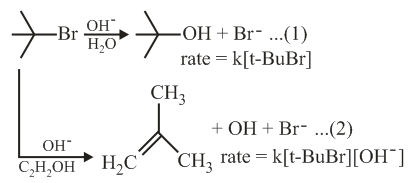
Which of the following statements is true:
The two elementary steps hidden in the statement are of different molecularities.
Let us first recall the general rate‐laws.
Case 1: $$S_N1/E1$$ mechanism (unimolecular)
Rate-determining step is the slow, first-order ionisation of the alkyl halide to give a carbocation.
Hence $$\text{Rate} = k\,[\text{substrate}]$$ and is independent of the concentration or basic strength of the nucleophile / base present in solution.
Case 2: $$S_N2/E2$$ mechanism (bimolecular)
Here the nucleophile / base attacks in the rate-determining transition state.
Hence $$\text{Rate} = k\,[\text{substrate}]\,[\text{base}]$$ and it does depend on both the substrate and the base. A stronger base such as $$^{\ominus}OR$$ will generally accelerate the step compared with $$OH^{\ominus}$$.
Looking at the options we infer:
• Statement A — says changing $$OH^{\ominus}$$ to $$^{\ominus}OR$$ “will have no effect on reaction (2)”. If reaction (2) is bimolecular, its rate will certainly change with the strength of the base, so A is false.
• Statement B — says changing the concentration of base will have no effect on reaction (1). If reaction (1) proceeds by an $$S_N1/E1$$ path, the rate is independent of base concentration, so B is true.
• Statement C — says doubling base concentration doubles the rate of both reactions. This is wrong because reaction (1) is zero-order in base.
• Statement D — says changing base concentration has no effect on reaction (2). Because reaction (2) is bimolecular, this is again false.
Therefore the only correct statement is:
Option B which is: Changing the concentration of base will have no effect on reaction (1).
Was this solution helpful?
Create a FREE account and get:
_1.webp)

Educational materials for JEE preparation

Ask our AI anything

AI can make mistakes. Please verify important information.
AI can make mistakes. Please verify important information.


