
Join Our JEE Preparation Group
Prep with like-minded aspirants; Get access to free daily tests and study material.
Sign in
Please select an account to continue using cracku.in
↓ →
Join Our JEE Preparation Group
Prep with like-minded aspirants; Get access to free daily tests and study material.
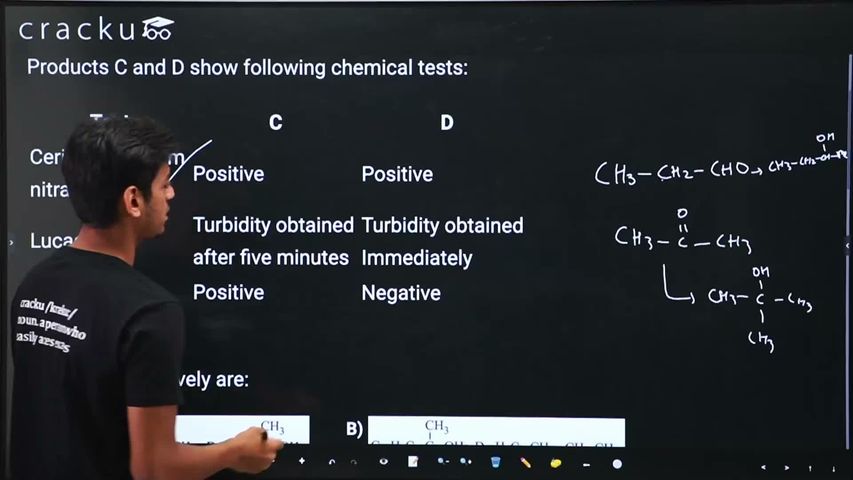
Two compounds A and B with same molecular formula $$(C_3H_6O)$$ undergo Grignard reaction with methylmagnesium bromide to give products C and D. Products C and D show following chemical tests:
| Test | C | D |
|---|---|---|
| Ceric ammonium nitrate Test | Positive | Positive |
| Lucas Test | Turbidity obtained after five minutes | Turbidity obtained Immediately |
| Iodoform Test | Positive | Negative |
C and D respectively are:
We begin by noting that both compounds A and B have the molecular formula $$C_3H_6O$$. Such a formula fits carbonyl compounds having three carbon atoms, namely
$$\text{propanal : }CH_3CH_2CHO\quad\text{(an aldehyde)}$$
$$\text{acetone : }CH_3COCH_3\quad\text{(a ketone)}$$
When a carbonyl compound is treated with a Grignard reagent, an alkyl group is added to the carbonyl carbon and the oxygen is converted into an alcohol after acidic work-up. Stating the general result first,
$$\text{R-C(=O)-R'} + CH_3MgBr \overset{H_3O^+}{\rightarrow} \text{R-C(OH)(CH}_3\text{)-R'}$$
So each carbonyl compound of three carbons will give an alcohol of four carbons, because one extra $$CH_3$$ group is introduced.
1. Reaction of propanal with $$CH_3MgBr$$
Starting carbonyl:
$$CH_3CH_2CHO$$
Addition of $$CH_3^-$$ from the Grignard reagent at the carbonyl carbon followed by protonation gives
$$CH_3CH_2C(OH)(CH_3)H \;=\;CH_3CH_2CH(OH)CH_3$$
This product is butan-2-ol, a secondary alcohol. Let us call it product C.
2. Reaction of acetone with $$CH_3MgBr$$
Starting carbonyl:
$$CH_3COCH_3$$
Addition of $$CH_3^-$$ and protonation gives
$$CH_3C(OH)(CH_3)CH_3 \;=\;(CH_3)_3C\,OH$$
This product is 2-methyl-2-propanol (tert-butyl alcohol), a tertiary alcohol. Let us call it product D.
Now we match C and D with the chemical tests given.
(i) Ceric ammonium nitrate test - any alcohol answers it, so both C and D should be positive, exactly as observed.
(ii) Lucas test - the rate of turbidity distinguishes the class of alcohol.
• Secondary alcohols turn turbid in about five minutes.
• Tertiary alcohols turn turbid immediately.
Product C is a secondary alcohol (butan-2-ol) → turbidity after five minutes.
Product D is a tertiary alcohol (tert-butyl alcohol) → instantaneous turbidity.
(iii) Iodoform test - positive for ethanol or any secondary alcohol that contains the fragment $$CH_3-CH(OH)-$$.
• Butan-2-ol possesses the $$CH_3-CH(OH)-$$ group, so C gives a positive iodoform test.
• tert-Butyl alcohol lacks that fragment, so D gives a negative iodoform test.
The behaviour predicted for butan-2-ol and tert-butyl alcohol coincides perfectly with the observations. Therefore
$$C = CH_3CH_2CH(OH)CH_3\quad(\text{butan-2-ol})$$
$$D = (CH_3)_3C\,OH\quad(\text{tert-butyl alcohol})$$
Looking at the options, these structures are listed together only in Option A:
$$C = H_3C-CH_2-CH(OH)-CH_3;\; D = H_3C-C(CH_3)_2-OH$$
Hence, the correct answer is Option A.
Was this solution helpful?
Click on the Email ☝️ to Watch the Video Solution
Create a FREE account and get:
_1.webp)

Educational materials for JEE preparation

Ask our AI anything

AI can make mistakes. Please verify important information.
AI can make mistakes. Please verify important information.


