
Join Our JEE Preparation Group
Prep with like-minded aspirants; Get access to free daily tests and study material.
Sign in
Please select an account to continue using cracku.in
↓ →
Join Our JEE Preparation Group
Prep with like-minded aspirants; Get access to free daily tests and study material.
The pulley shown in the figure is made using a thin rim and two rods of length equal to the diameter of the rim. The rim and each rod have a mass of M. Two blocks of mass of M and m are attached to two ends of a light string passing over the pulley, which is hinged to rotate freely in vertical plane about its center. The magnitudes of the acceleration experienced by the blocks is ___________
(assume no slipping of string on pulley).
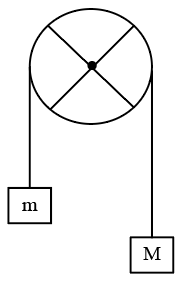
The pulley consists of a thin rim and two rods (length $$L = 2R$$).
Rim: $$I_{rim} = MR^2$$
Two Rods (about center): $$I_{rods} = 2 \times \left( \frac{1}{12} M L^2 \right) = 2 \times \left( \frac{1}{12} M (2R)^2 \right) = \frac{2}{3} MR^2$$
Total $$I$$: $$I = MR^2 + \frac{2}{3} MR^2 = \frac{5}{3} MR^2$$
Equations:
Force on $$M$$: $$Mg - T_2 = Ma$$
Force on $$m$$: $$T_1 - mg = ma$$
Torque on Pulley: $$(T_2 - T_1)R = I\alpha \implies T_2 - T_1 = \frac{I a}{R^2}$$
$$(Mg - Ma) - (mg + ma) = \frac{\frac{5}{3} MR^2 \cdot a}{R^2}$$
$$(M - m)g - (M + m)a = \frac{5}{3} Ma$$
$$(M - m)g = \left( M + m + \frac{5}{3} M \right) a$$
$$(M - m)g = \left( \frac{8}{3} M + m \right) a$$
$$a = \frac{(M - m)g}{\frac{8}{3} M + m}$$
Was this solution helpful?
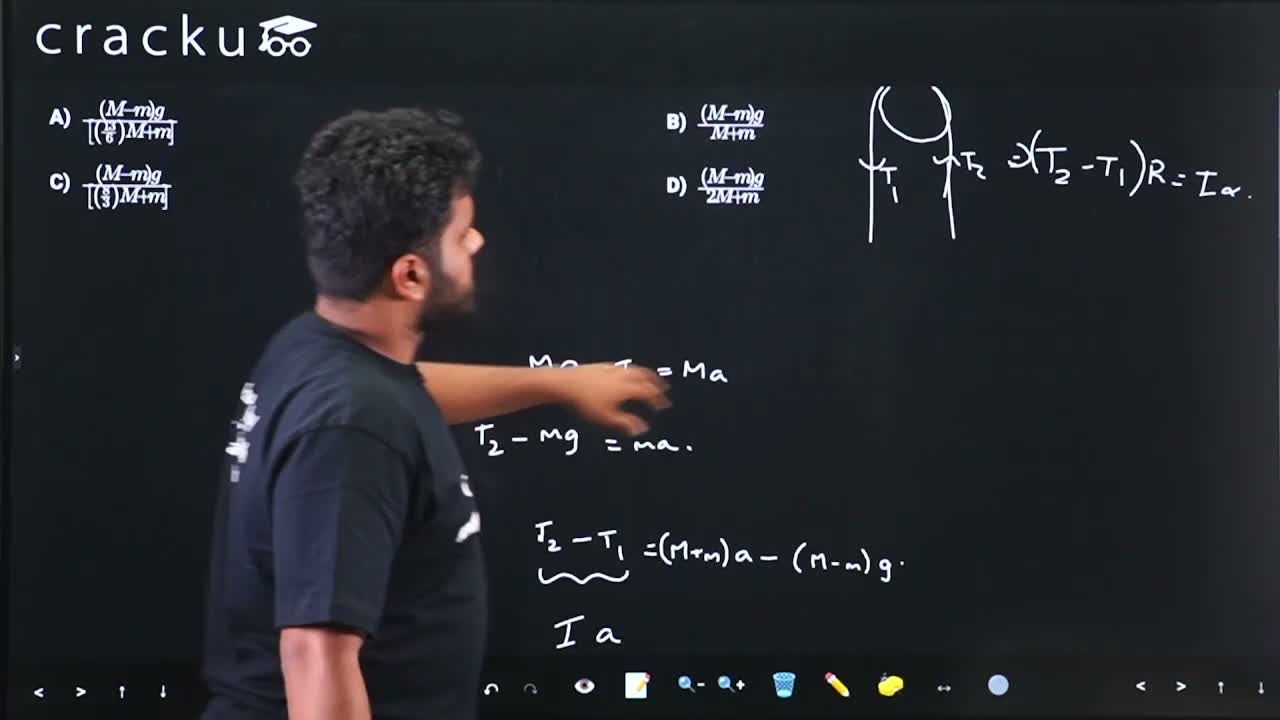
Click on the Email ☝️ to Watch the Video Solution
Create a FREE account and get:
_1.webp)

Educational materials for JEE preparation

Ask our AI anything

AI can make mistakes. Please verify important information.
AI can make mistakes. Please verify important information.
