
Join Our JEE Preparation Group
Prep with like-minded aspirants; Get access to free daily tests and study material.
Sign in
Please select an account to continue using cracku.in
↓ →
Join Our JEE Preparation Group
Prep with like-minded aspirants; Get access to free daily tests and study material.
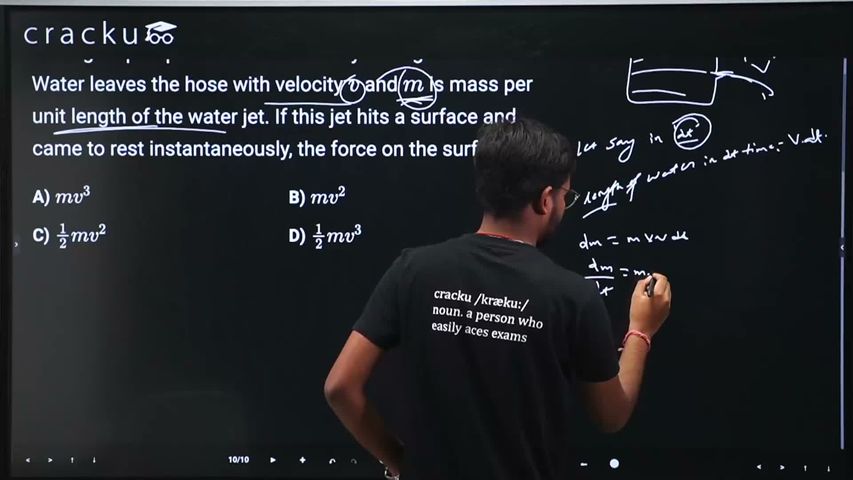
An engine pumps water continuously through a hose. Water leaves the hose with velocity $$v$$ and $$m$$ is mass per unit length of the water jet. If this jet hits a surface and came to rest instantaneously, the force on the surface is
Let the linear mass density (mass per unit length) of the water jet be $$m$$ in $$\text{kg\,m}^{-1}$$ and let the speed with which the water emerges from the hose be $$v$$.
Step 1 : Mass flow rate
In a small time interval $$dt$$ the jet covers a length $$v\,dt$$, so the mass that leaves the hose in this time is
$$dm = m\,(v\,dt) = m\,v\,dt$$
Hence the mass flow rate (mass per second) is
$$\frac{dm}{dt} = m\,v \quad\text{kg\,s}^{-1}$$
Step 2 : Momentum change per second
Each small element of water arrives with initial velocity $$v$$ and is brought to rest when it hits the surface, so its change in velocity is $$\Delta v = v - 0 = v$$.
Change in momentum of the element:
$$d(\text{momentum}) = dm \,\Delta v = (m\,v\,dt)\,v = m\,v^{2}\,dt$$
Step 3 : Force on the surface
Force is the rate of change of momentum:
$$F = \frac{d(\text{momentum})}{dt} = \frac{m\,v^{2}\,dt}{dt} = m\,v^{2}$$
Therefore, the constant force exerted by the water jet on the surface is $$F = m\,v^{2}$$.
Option B which is: $$mv^{2}$$
Was this solution helpful?
Click on the Email ☝️ to Watch the Video Solution
Create a FREE account and get:
_1.webp)

Educational materials for JEE preparation

Ask our AI anything

AI can make mistakes. Please verify important information.
AI can make mistakes. Please verify important information.


