
Join Our JEE Preparation Group
Prep with like-minded aspirants; Get access to free daily tests and study material.
Sign in
Please select an account to continue using cracku.in
↓ →
Join Our JEE Preparation Group
Prep with like-minded aspirants; Get access to free daily tests and study material.
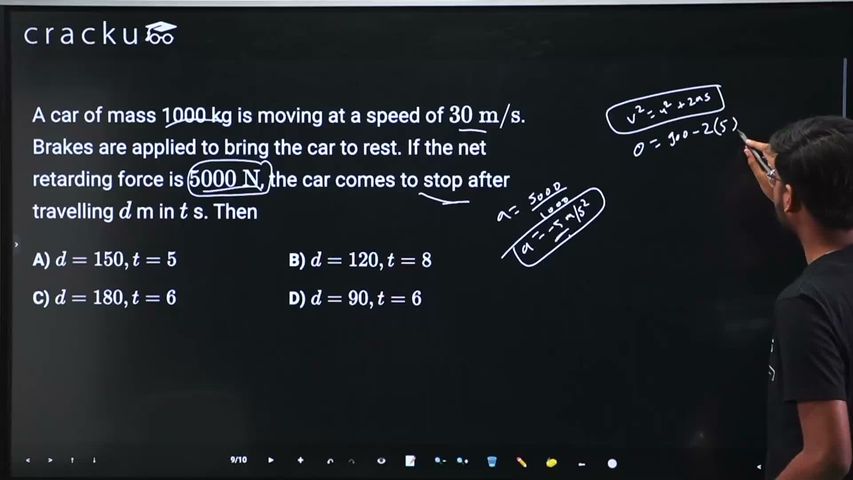
A car of mass 1000 kg is moving at a speed of $$30\ \text{m/s}$$. Brakes are applied to bring the car to rest. If the net retarding force is $$5000\ \text{N}$$, the car comes to stop after travelling $$d$$ m in $$t$$ s. Then
Initial speed of the car is $$u = 30\ \text{m/s}$$. The brakes provide a retarding (opposite) force $$F = 5000\ \text{N}$$ on a car of mass $$m = 1000\ \text{kg}$$.
From Newton’s second law, the resulting acceleration (here, deceleration) is
$$a = \frac{F}{m} = \frac{5000}{1000} = 5\ \text{m/s}^2.$$
Since it opposes the motion, take it as $$a = -5\ \text{m/s}^2.$$
1. Stopping distance $$d$$ (use $$v^2 = u^2 + 2 a s$$):
Final speed $$v = 0$$, so
$$0 = (30)^2 + 2(-5)\,d$$
$$\Rightarrow -10\,d = -900$$
$$\Rightarrow d = 90\ \text{m}.$$
2. Time to stop $$t$$ (use $$v = u + a t$$):
$$0 = 30 + (-5)\,t$$
$$\Rightarrow 5\,t = 30$$
$$\Rightarrow t = 6\ \text{s}.$$
Thus the car travels $$90\ \text{m}$$ and takes $$6\ \text{s}$$ to come to rest.
Option D which is: $$d = 90, t = 6$$
Was this solution helpful?
Click on the Email ☝️ to Watch the Video Solution
Create a FREE account and get:
_1.webp)

Educational materials for JEE preparation

Ask our AI anything

AI can make mistakes. Please verify important information.
AI can make mistakes. Please verify important information.


