
Join Our JEE Preparation Group
Prep with like-minded aspirants; Get access to free daily tests and study material.
Sign in
Please select an account to continue using cracku.in
↓ →
Join Our JEE Preparation Group
Prep with like-minded aspirants; Get access to free daily tests and study material.
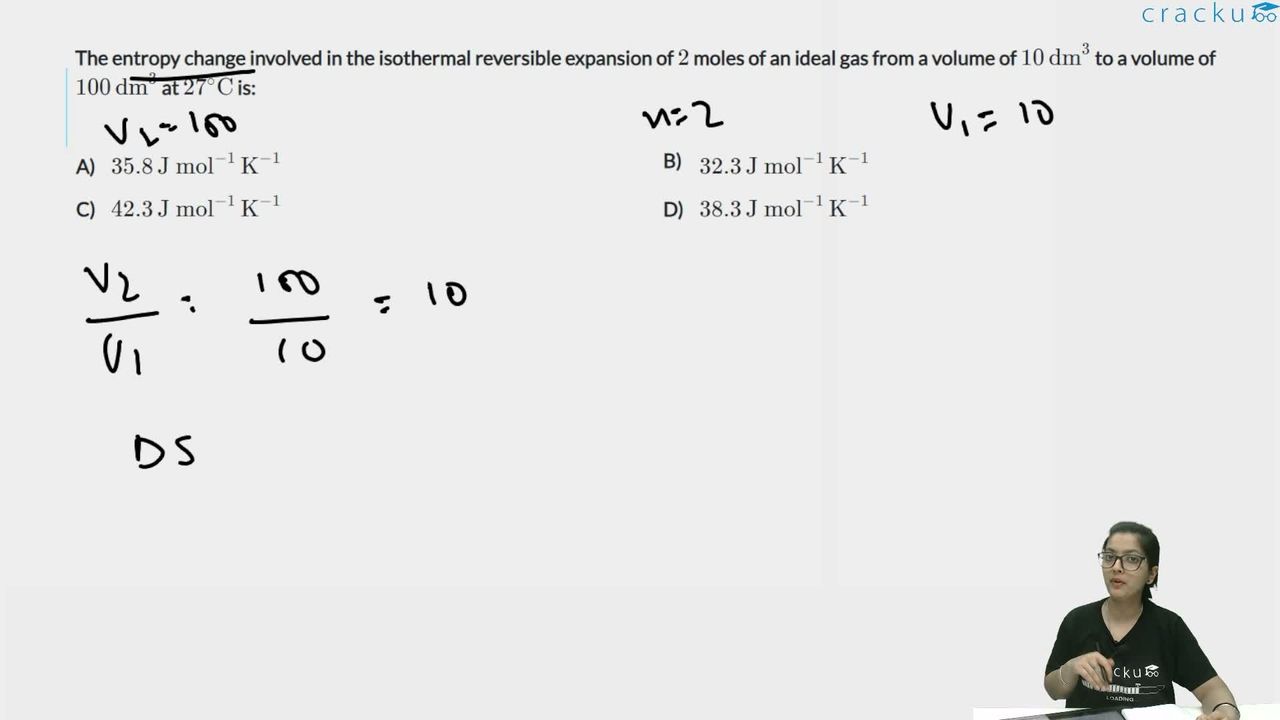
The entropy change involved in the isothermal reversible expansion of $$2$$ moles of an ideal gas from a volume of $$10 \, \text{dm}^3$$ to a volume of $$100 \, \text{dm}^3$$ at $$27^\circ \text{C}$$ is:
For an isothermal, reversible expansion of an ideal gas the entropy change is given by
$$\Delta S = nR \ln \frac{V_2}{V_1}$$
where
$$n = 2 \;\text{mol}, \qquad R = 8.314 \;\text{J mol}^{-1}\text{K}^{-1}, \qquad V_1 = 10 \,\text{dm}^3, \qquad V_2 = 100 \,\text{dm}^3$$
1. Evaluate the volume ratio:
$$\frac{V_2}{V_1} = \frac{100}{10} = 10$$
2. Substitute in the entropy formula:
$$\Delta S = 2 \times 8.314 \times \ln 10$$
3. Use $$\ln 10 = 2.302585$$ (keep four significant figures for accuracy).
$$\Delta S = 16.628 \times 2.302585 = 38.27 \;\text{J K}^{-1}$$
4. Rounding to three significant figures gives
$$\Delta S \approx 38.3 \;\text{J K}^{-1}$$
Because the calculation already includes the given 2 moles, this is the required entropy change for the process. The options show units of $$\text{J mol}^{-1}\text{K}^{-1}$$, but numerically Option D matches our result.
Hence, the correct choice is:
Option D which is: $$38.3 \, \text{J mol}^{-1} \, \text{K}^{-1}$$
Was this solution helpful?
Click on the Email ☝️ to Watch the Video Solution
Create a FREE account and get:
_1.webp)

Educational materials for JEE preparation

Ask our AI anything

AI can make mistakes. Please verify important information.
AI can make mistakes. Please verify important information.


