
Join Our JEE Preparation Group
Prep with like-minded aspirants; Get access to free daily tests and study material.
Sign in
Please select an account to continue using cracku.in
↓ →
Join Our JEE Preparation Group
Prep with like-minded aspirants; Get access to free daily tests and study material.
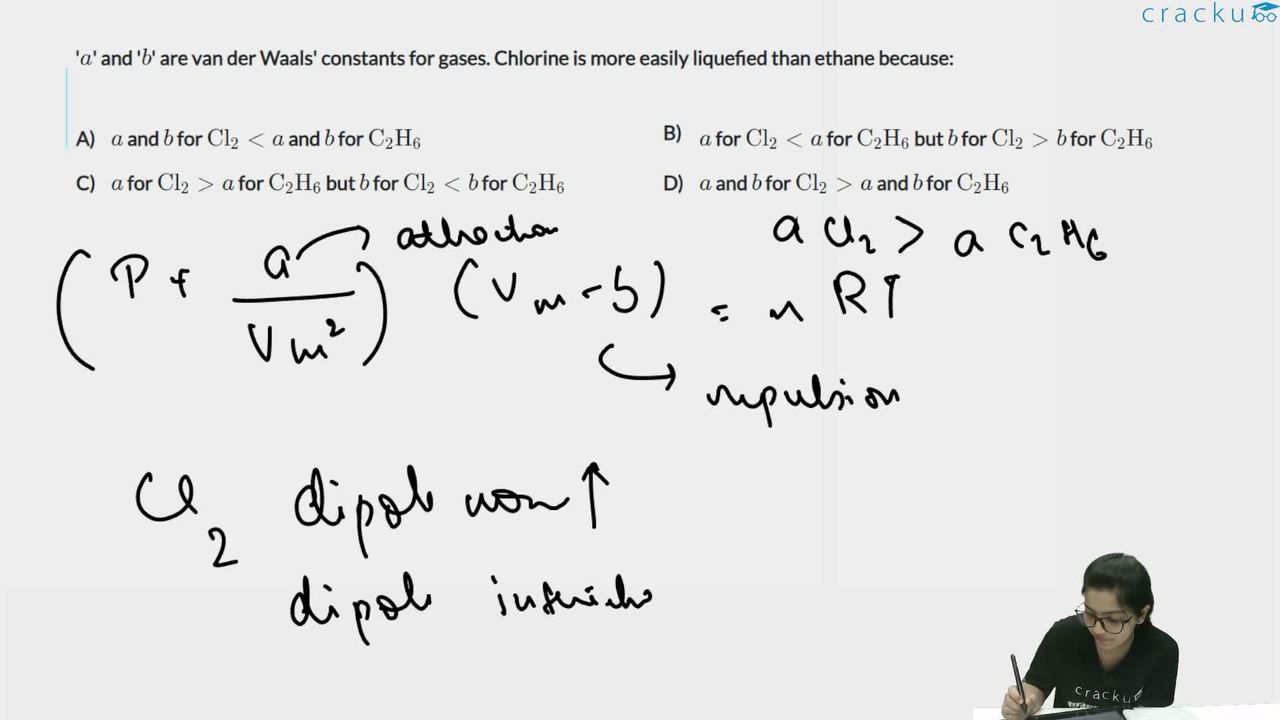
'$$a$$' and '$$b$$' are van der Waals' constants for gases. Chlorine is more easily liquefied than ethane because:
The van der Waals equation for one mole of a real gas is
$$\left(P+\frac{a}{V_m^{\,2}}\right)\left(V_m-b\right)=RT$$
where
• $$a$$ measures the magnitude of intermolecular attractions (greater $$a \Rightarrow$$ stronger attractive forces).
• $$b$$ represents the effective excluded volume of one mole of molecules (larger $$b \Rightarrow$$ bulkier molecules, greater repulsion).
For a gas to liquefy easily it should
1. possess strong intermolecular attractions → a large $$a$$ value,
2. have comparatively small molecular size → a small $$b$$ value so that molecules can approach one another more closely.
Comparing chlorine ($$\text{Cl}_2$$) and ethane ($$\text{C}_2\text{H}_6$$):
(i) Chlorine atoms contain many more electrons than the atoms in ethane. This makes the electron cloud of $$\text{Cl}_2$$ highly polarisable, creating strong instantaneous dipole-induced-dipole (London dispersion) forces. Hence $$a_{\text{(Cl}_2)} \gt a_{\text{(C}_2\text{H}_6)}$$.
(ii) Although $$\text{Cl}_2$$ is heavier, its linear diatomic structure gives it a smaller excluded volume than the three-dimensional, zig-zag ethane molecule. Therefore $$b_{\text{(Cl}_2)} \lt b_{\text{(C}_2\text{H}_6)}$$.
Because $$\text{Cl}_2$$ has both a larger $$a$$ and a smaller $$b$$ than $$\text{C}_2\text{H}_6$$, chlorine condenses (liquefies) more readily.
Thus the correct statement is:
Option C which is: $$a$$ for $$\text{Cl}_2 \gt a$$ for $$\text{C}_2\text{H}_6$$ but $$b$$ for $$\text{Cl}_2 \lt b$$ for $$\text{C}_2\text{H}_6$$.
Was this solution helpful?
Click on the Email ☝️ to Watch the Video Solution
Create a FREE account and get:
_1.webp)

Educational materials for JEE preparation

Ask our AI anything

AI can make mistakes. Please verify important information.
AI can make mistakes. Please verify important information.


