Join Our JEE Preparation Group
Prep with like-minded aspirants; Get access to free daily tests and study material.
Sign in
Please select an account to continue using cracku.in
↓ →
Join Our JEE Preparation Group
Prep with like-minded aspirants; Get access to free daily tests and study material.
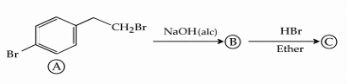
The given sequence involves two very common reactions of haloalkanes:
• alcoholic $$KOH$$ ⇒ dehydrohalogenation (E2) to give an alkene
• addition of $$HBr$$ in the presence of organic peroxide ⇒ anti-Markovnikov (free-radical) addition of HBr to an alkene.
Let us take the haloalkane (A) to be the secondary bromide $$CH_3-CHBr-CH_2-CH_3$$ (2-bromobutane).
Step 1 : Dehydrohalogenation of (A)
With alcoholic $$KOH$$, an E2 elimination occurs. The most accessible β-hydrogen is on either adjacent carbon, and the major product is the more substituted alkene, $$CH_3-CH = CH-CH_3$$, i.e. but-2-ene.
Hence, $$B = CH_3-CH = CH-CH_3$$ (but-2-ene).
Step 2 : Anti-Markovnikov addition of HBr to (B)
In the presence of an organic peroxide, HBr adds across the double bond by a free-radical mechanism. The bromine atom attaches to the carbon that already has the larger number of hydrogens (anti-Markovnikov rule). For but-2-ene this gives
$$CH_3-CH = CH-CH_3 \;\xrightarrow[\text{peroxide}]{HBr}\; CH_3-CH_2-CH_2-CH_2Br$$
Thus, $$C = CH_3-CH_2-CH_2-CH_2Br$$ (1-bromobutane).
Relationship between (A) and (C)
(A) is 2-bromobutane while (C) is 1-bromobutane. They have the same molecular formula $$C_4H_9Br$$ but differ in the position of the bromine atom on the carbon chain. Therefore, (A) and (C) are position isomers (constitutional isomers differing in the position of the halogen).
Hence,
(B) = but-2-ene,
(C) = 1-bromobutane,
and (A) & (C) are position isomers.
Option C is correct.
Was this solution helpful?
Create a FREE account and get:
_1.webp)

Educational materials for JEE preparation

Ask our AI anything

AI can make mistakes. Please verify important information.
AI can make mistakes. Please verify important information.