
Join Our JEE Preparation Group
Prep with like-minded aspirants; Get access to free daily tests and study material.
Sign in
Please select an account to continue using cracku.in
↓ →
Join Our JEE Preparation Group
Prep with like-minded aspirants; Get access to free daily tests and study material.
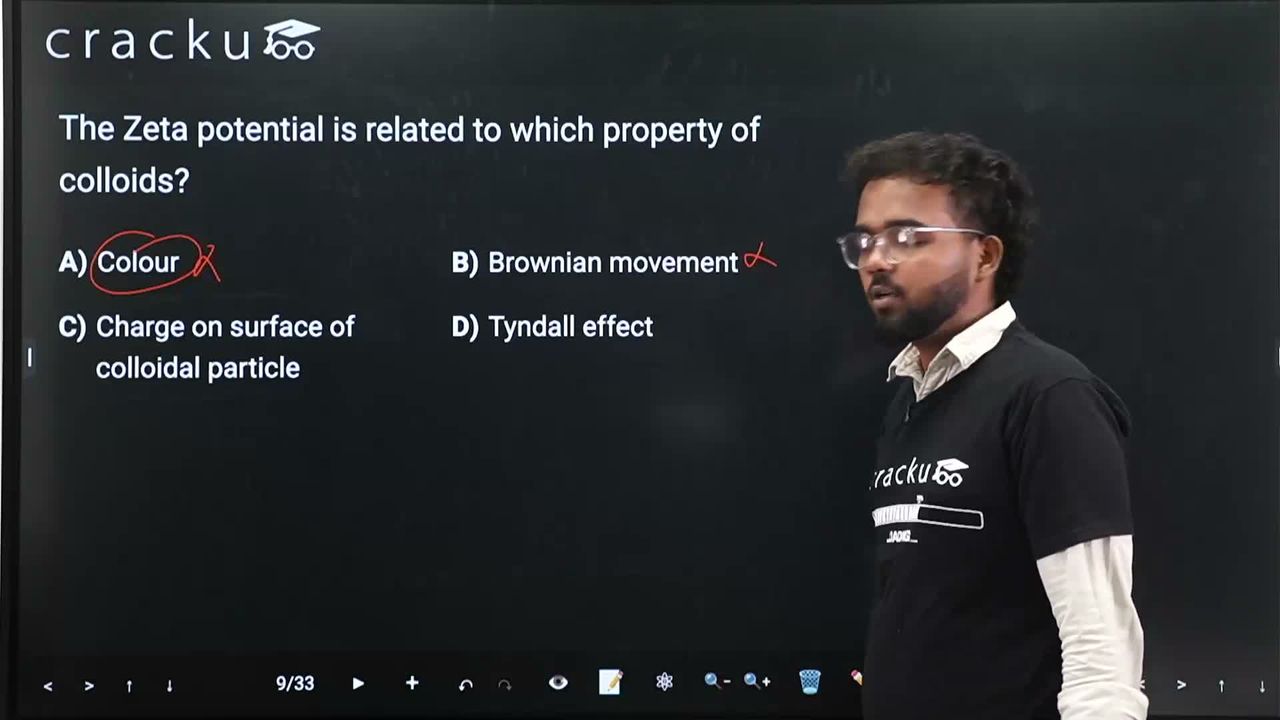
The Zeta potential is related to which property of colloids?
We need to identify which property of colloids the Zeta potential is related to.
Understanding Zeta Potential:
Zeta potential (also called electrokinetic potential) is the electric potential at the boundary of the double layer surrounding a colloidal particle. It is the potential difference between the dispersion medium and the stationary layer of fluid attached to the dispersed particle.
Evaluating the Options:
Option A: Colour
The colour of colloids is related to the scattering of light (Tyndall effect) and particle size, not to the zeta potential. Incorrect.
Option B: Brownian movement
Brownian movement is caused by the random bombardment of colloidal particles by molecules of the dispersion medium. It is related to thermal energy and particle size, not to zeta potential. Incorrect.
Option C: Charge on surface of colloidal particle
Zeta potential is directly related to the charge on the surface of colloidal particles. It measures the magnitude of the electrostatic charge at the electrical double layer around the particle. A higher zeta potential indicates greater stability of the colloidal solution due to stronger electrostatic repulsion between particles. This is correct.
Option D: Tyndall effect
The Tyndall effect is the scattering of light by colloidal particles and is related to particle size and the wavelength of light, not to zeta potential. Incorrect.
Hence, the correct answer is Option C: Charge on surface of colloidal particle.
Was this solution helpful?
Click on the Email ☝️ to Watch the Video Solution
Create a FREE account and get:
_1.webp)

Educational materials for JEE preparation

Ask our AI anything

AI can make mistakes. Please verify important information.
AI can make mistakes. Please verify important information.
