
Join Our JEE Preparation Group
Prep with like-minded aspirants; Get access to free daily tests and study material.
Sign in
Please select an account to continue using cracku.in
↓ →
Join Our JEE Preparation Group
Prep with like-minded aspirants; Get access to free daily tests and study material.
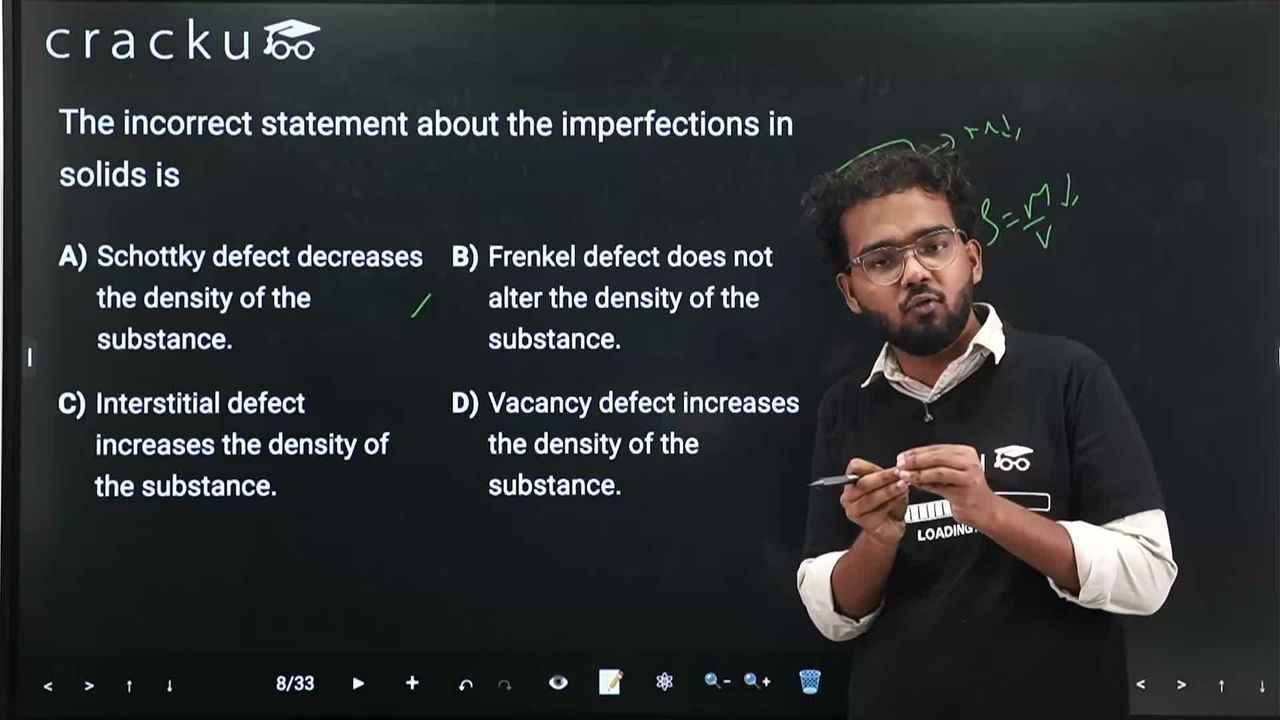
The incorrect statement about the imperfections in solids is
We need to identify the incorrect statement about imperfections (defects) in solids.
Option A: "Schottky defect decreases the density of the substance."
In a Schottky defect, equal numbers of cations and anions are missing from their lattice sites, creating vacancies. Since atoms are missing but the volume remains approximately the same, the density decreases.
This statement is correct.
Option B: "Frenkel defect does not alter the density of the substance."
In a Frenkel defect, an ion leaves its normal lattice site and occupies an interstitial site. No atom leaves the crystal — it just moves to a different position within the same crystal. So the total number of atoms and the volume remain the same, meaning the density does not change.
This statement is correct.
Option C: "Interstitial defect increases the density of the substance."
In an interstitial defect, extra atoms or ions occupy the interstitial spaces (voids) in the crystal. This adds extra mass without significantly changing the volume, so the density increases.
This statement is correct.
Option D: "Vacancy defect increases the density of the substance."
In a vacancy defect, some atoms are missing from their lattice positions. This means the crystal has fewer atoms than the ideal structure while maintaining roughly the same volume. Therefore, the density decreases, not increases.
This statement is incorrect.
Hence, the correct answer is Option D.
Was this solution helpful?
Click on the Email ☝️ to Watch the Video Solution
Create a FREE account and get:
_1.webp)

Educational materials for JEE preparation

Ask our AI anything

AI can make mistakes. Please verify important information.
AI can make mistakes. Please verify important information.
