
Join Our JEE Preparation Group
Prep with like-minded aspirants; Get access to free daily tests and study material.
Sign in
Please select an account to continue using cracku.in
↓ →
Join Our JEE Preparation Group
Prep with like-minded aspirants; Get access to free daily tests and study material.
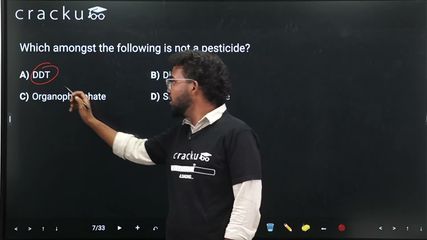
We need to identify which of the given substances is not a pesticide.
What is a Pesticide?
A pesticide is any substance used to kill, repel, or control pests. Pesticides include several categories:
- Insecticides: Used to kill insects (e.g., DDT, BHC, Malathion)
- Herbicides: Used to kill weeds (e.g., 2,4-D, Atrazine)
- Fungicides: Used to kill fungi
- Rodenticides: Used to kill rodents
Now let us evaluate each option:
Option A: DDT (Dichlorodiphenyltrichloroethane)
DDT is the most well-known example of an organochlorine insecticide. It was widely used to control mosquitoes and agricultural pests.
Option B: Dieldrin
Dieldrin is another organochlorine insecticide. It was extensively used against soil-dwelling insects and crop pests.
Option C: Organophosphate
Organophosphates are an entire class of insecticide pesticides. Common examples include malathion and parathion. These are examples of pesticides that work by inhibiting the enzyme acetylcholinesterase.
Option D: Sodium Arsenite
Sodium arsenite ($$NaAsO_2$$) is an inorganic arsenic compound. It is primarily used as a herbicide (weedicide) and rodenticide (rat poison). While herbicides and rodenticides are technically types of pesticides, sodium arsenite is not classified among the standard NCERT pesticide examples. In the NCERT framework, the term "pesticide" is used specifically for insecticides like DDT, Dieldrin, and organophosphates. Sodium arsenite does not belong to the organochlorine or organophosphate classes and is not listed as a pesticide.
Hence, the correct answer is Option D: Sodium Arsenite.
Was this solution helpful?
Click on the Email ☝️ to Watch the Video Solution
Create a FREE account and get:
_1.webp)

Educational materials for JEE preparation

Ask our AI anything

AI can make mistakes. Please verify important information.
AI can make mistakes. Please verify important information.
