
Join Our JEE Preparation Group
Prep with like-minded aspirants; Get access to free daily tests and study material.
Sign in
Please select an account to continue using cracku.in
↓ →
Join Our JEE Preparation Group
Prep with like-minded aspirants; Get access to free daily tests and study material.
Based on lattice energy and other considerations, which one of the following alkali metal chloride is expected to have the highest melting point?
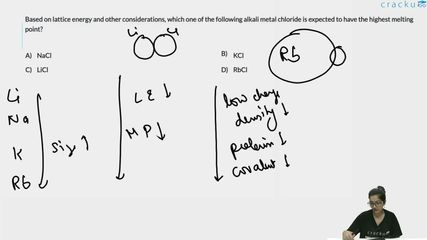
The melting point of ionic compounds generally depends on two competing periodic trends:
$$\text{LiCl}$$:
Because the $$\text{Li}^+$$ ion is exceptionally small, it highly polarizes the $$\text{Cl}^-$$ ion, making $$\text{LiCl}$$ predominantly covalent. Consequently, its melting point drops unexpectedly low ($$605 \ ^\circ\text{C}$$).
$$\text{NaCl}$$:
The $$\text{Na}^+$$ ion is larger than $$\text{Li}^+$$, meaning it has a much lower polarizing power, and the compound retains highly ideal ionic character. At the same time, because $$\text{Na}^+$$ is smaller than $$\text{K}^+$$ and $$\text{Rb}^+$$, it maintains a relatively high lattice energy. This perfect balance between strong ionic binding and high lattice energy gives it the peak melting point ($$801 \ ^\circ\text{C}$$).
$$\text{KCl}$$ and $$\text{RbCl}$$:
As we move further down to $$\text{K}^+$$ and $$\text{Rb}^+$$, the compounds remain ionic, but the increasing size of the cations drastically diminishes the lattice energy. As a result, their melting points decrease progressively ($$770 \ ^\circ\text{C}$$ for $$\text{KCl}$$ and $$718 \ ^\circ\text{C}$$ for $$\text{RbCl}$$).
Accounting for both the decrease in lattice energy and the introduction of covalent character via Fajan's rules, the overall melting point order for group 1 chlorides is:
$$\text{NaCl} > \text{KCl} > \text{RbCl} > \text{LiCl}$$
Therefore, sodium chloride possesses the highest melting point among the choices.
Answer: Option A — NaCl
Was this solution helpful?
Click on the Email ☝️ to Watch the Video Solution
Create a FREE account and get:
_1.webp)

Educational materials for JEE preparation

Ask our AI anything

AI can make mistakes. Please verify important information.
AI can make mistakes. Please verify important information.


