
Join Our JEE Preparation Group
Prep with like-minded aspirants; Get access to free daily tests and study material.
Sign in
Please select an account to continue using cracku.in
↓ →
Join Our JEE Preparation Group
Prep with like-minded aspirants; Get access to free daily tests and study material.
But-2-yne is reacted separately with one mole of Hydrogen as shown below:
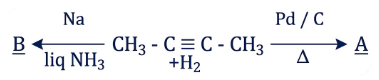
Identify the incorrect statements from the options given below:
A. A is more soluble than B.
B. The boiling point & melting point of A are higher and lower than B respectively.
C. A is more polar than B because dipole moment of A is zero.
D. $$Br_2$$ adds easily to B than A.
The partial catalytic hydrogenation of $$CH_3-C \equiv C-CH_3$$ (but-2-yne) gives two stereo-isomeric alkenes, depending on the reagent used.
Case 1:$$Na/NH_3\,(l)$$ (Birch reduction, anti-addn. of $$H_2$$) breaks the triple bond from opposite sides. The product is $$\mathbf{A} :$$ trans-2-butene.
Case 2:Pd-CaCO$$ _3$$/PbO (Lindlar’s catalyst, syn-addn. of $$H_2$$) adds both hydrogens to the same face. The product is $$\mathbf{B} :$$ cis-2-butene.
Thus
$$\mathbf{A}= \text{trans-}CH_3-CH=CH-CH_3 \qquad \qquad \mathbf{B}= \text{cis-}CH_3-CH=CH-CH_3$$
Now analyse each statement:
Statement A “$$A$$ is more soluble than $$B$$.”
Solubility is generally discussed in non-polar organic solvents for hydrocarbons.
trans-2-butene ($$\mu = 0$$ D) is completely non-polar, hence dissolves a little better in non-polar media than the slightly polar cis-isomer ($$\mu \approx 0.35$$ D).
Statement A is therefore correct.
Statement B “The boiling point & melting point of $$A$$ are higher and lower than $$B$$ respectively.”
Experimental data:
$$\text{B.P. (trans)} = 0.9^{\circ}C \lt \text{B.P. (cis)} = 3.7^{\circ}C$$
$$\text{M.P. (trans)} = -105^{\circ}C \gt \text{M.P. (cis)} = -139^{\circ}C$$
So, compared with $$B$$ (cis), $$A$$ (trans) has a lower boiling point and a higher melting point, opposite to what is stated.
Statement B is incorrect.
Statement C “$$A$$ is more polar than $$B$$ because dipole moment of $$A$$ is zero.”
A molecule with zero dipole moment is, by definition, non-polar. Hence the cause given contradicts the claim, making the whole statement false.
Statement C is incorrect.
Statement D “$$Br_2$$ adds easily to $$B$$ than $$A$$.”
In electrophilic addition of $$Br_2$$ the reagent approaches the $$\pi$$-bond.
The cis-isomer ($$B$$) has both bulky $$CH_3$$ groups on the same side and offers greater steric hindrance than the trans-isomer ($$A$$). Therefore bromine adds more readily to $$A$$, not to $$B$$.
Statement D is incorrect.
Thus the statements that are incorrect are B, C and D.
Option B which is: B, C and D only
Was this solution helpful?
_1.webp)

Educational materials for JEE preparation

Ask our AI anything

AI can make mistakes. Please verify important information.
AI can make mistakes. Please verify important information.