
Join Our JEE Preparation Group
Prep with like-minded aspirants; Get access to free daily tests and study material.
Sign in
Please select an account to continue using cracku.in
↓ →
Join Our JEE Preparation Group
Prep with like-minded aspirants; Get access to free daily tests and study material.
Resonance in carbonate ion $$CO_3^{2-}$$ i
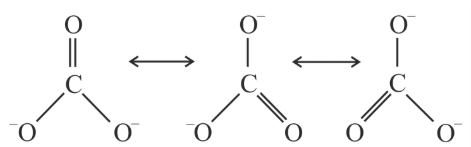
shown with three resonance structures. Which of the following is true?
We need to evaluate the given statements regarding the resonance structures of the carbonate ion ($$\text{CO}_3^{2-}$$) and identify which statement is true according to the concepts of chemical bonding.
Resonance is a theoretical concept used when a single Lewis structure cannot correctly represent a molecule or ion. The individual Lewis structures drawn are called contributing structures (or canonical forms).
Option A: It is possible to identify each structure individually by some physical or chemical method.
This statement is incorrect. Because canonical structures are imaginary and do not actually exist in reality, they cannot be isolated, observed, or identified by any experimental method.
Option B: All these structures are in dynamic equilibrium with each other.
This statement is incorrect. Resonance is entirely different from chemical equilibrium. In an equilibrium, there is an actual interconversion of real chemical species. In resonance, there is no physical shifting or flipping between the structures.
Option C: Each structure exists for equal amount of time.
This statement is incorrect. Since the structures do not exist at all, they do not spend time converting into one another. The resonance hybrid is a weighted average that remains constant over time.
Option D: $$\text{CO}_3^{2-}$$ has a single structure i.e., resonance hybrid of the above three structures.
This statement is correct. The carbonate ion possesses only one true, permanent molecular structure: the resonance hybrid. In this hybrid, the negative charges and the double-bond character are evenly delocalized across all three oxygen atoms, making all three $$\text{C--O}$$ bond lengths completely identical.
Resonance structures are simply a tool to represent localized electron distributions, whereas the true nature of the molecule is captured solely by its single hybrid structure.
Answer: Option D — $$\text{CO}_3^{2-}$$ has a single structure i.e., resonance hybrid of the above three structures.
Was this solution helpful?
_1.webp)

Educational materials for JEE preparation

Ask our AI anything

AI can make mistakes. Please verify important information.
AI can make mistakes. Please verify important information.