
Join Our JEE Preparation Group
Prep with like-minded aspirants; Get access to free daily tests and study material.
Sign in
Please select an account to continue using cracku.in
↓ →
Join Our JEE Preparation Group
Prep with like-minded aspirants; Get access to free daily tests and study material.
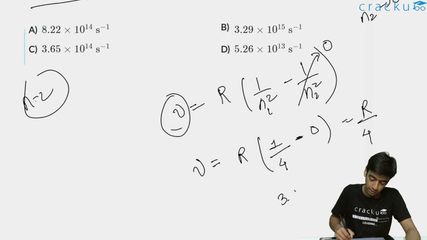
The limiting line in Balmer series will have a frequency of (Rydberg constant, $$R_\infty = 3.29 \times 10^{15}\ \text{cycles/s}$$)
The Balmer series corresponds to electronic transitions that terminate at the level $$n_1 = 2$$ in the hydrogen atom.
For any line of a hydrogen series, the Rydberg formula gives the frequency $$\nu$$ as:
$$\nu = R_\infty\left(\frac{1}{n_1^{2}} - \frac{1}{n_2^{2}}\right)$$
where $$n_1$$ is the lower (final) level and $$n_2$$ (>$$n_1$$) is the upper (initial) level.
The limiting (or series) line is obtained when the electron falls from $$n_2 = \infty$$ to $$n_1 = 2$$. At $$n_2 = \infty$$, the term $$\dfrac{1}{n_2^{2}}$$ becomes zero. Hence
$$\nu_{\text{limit}} = R_\infty\left(\frac{1}{2^{2}} - 0\right) = R_\infty \times \frac{1}{4}$$
Insert the given value $$R_\infty = 3.29 \times 10^{15}\ \text{cycles s}^{-1}$$:
$$\nu_{\text{limit}} = \frac{3.29 \times 10^{15}}{4} = 0.8225 \times 10^{15}\ \text{s}^{-1} = 8.225 \times 10^{14}\ \text{s}^{-1}$$
Rounded to three significant figures, $$\nu_{\text{limit}} \approx 8.22 \times 10^{14}\ \text{s}^{-1}$$.
Option A which is: $$8.22 \times 10^{14}\ \text{s}^{-1}$$
Was this solution helpful?
Click on the Email ☝️ to Watch the Video Solution
Create a FREE account and get:
_1.webp)

Educational materials for JEE preparation

Ask our AI anything

AI can make mistakes. Please verify important information.
AI can make mistakes. Please verify important information.


