
Join Our JEE Preparation Group
Prep with like-minded aspirants; Get access to free daily tests and study material.
Sign in
Please select an account to continue using cracku.in
↓ →
Join Our JEE Preparation Group
Prep with like-minded aspirants; Get access to free daily tests and study material.
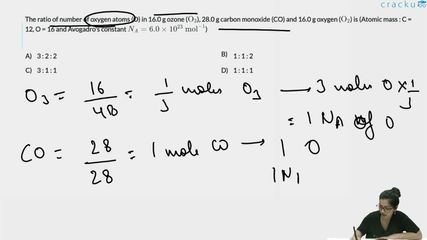
The ratio of number of oxygen atoms (O) in 16.0 g ozone ($$\text{O}_3$$), 28.0 g carbon monoxide (CO) and 16.0 g oxygen ($$\text{O}_2$$) is (Atomic mass : C = 12, O = 16 and Avogadro's constant $$N_A = 6.0 \times 10^{23}\ \text{mol}^{-1}$$)
Molar mass of $$\text{O}_3 = 3 \times 16 = 48\ \text{g mol}^{-1}$$.
Moles of $$\text{O}_3$$ in 16.0 g = $$\frac{16.0}{48} = \frac13$$ mol.
Each $$\text{O}_3$$ molecule contains 3 oxygen atoms, so number of oxygen atoms = $$\frac13 \times 3 N_A = 1N_A$$.
Molar mass of CO = $$12 + 16 = 28\ \text{g mol}^{-1}$$.
Moles of CO in 28.0 g = $$\frac{28.0}{28} = 1$$ mol.
Each CO molecule contains 1 oxygen atom, so number of oxygen atoms = $$1 \times 1 N_A = 1N_A$$.
Molar mass of $$\text{O}_2 = 2 \times 16 = 32\ \text{g mol}^{-1}$$.
Moles of $$\text{O}_2$$ in 16.0 g = $$\frac{16.0}{32} = \frac12$$ mol.
Each $$\text{O}_2$$ molecule contains 2 oxygen atoms, so number of oxygen atoms = $$\frac12 \times 2 N_A = 1N_A$$.
Thus, the numbers of oxygen atoms are all equal: $$N_A : N_A : N_A$$.
Required ratio = $$1 : 1 : 1$$.
Option D which is: 1 : 1 : 1
Was this solution helpful?
Click on the Email ☝️ to Watch the Video Solution
Create a FREE account and get:
_1.webp)

Educational materials for JEE preparation

Ask our AI anything

AI can make mistakes. Please verify important information.
AI can make mistakes. Please verify important information.


