
Join Our JEE Preparation Group
Prep with like-minded aspirants; Get access to free daily tests and study material.
Sign in
Please select an account to continue using cracku.in
↓ →
Join Our JEE Preparation Group
Prep with like-minded aspirants; Get access to free daily tests and study material.
Match List I with List II
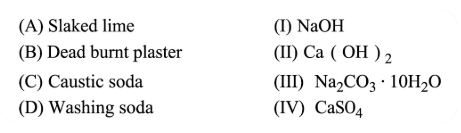
Choose the correct answer form the options given below:
List I contains four superlatives; we must select from List II the element that actually exhibits each of those extreme properties by using periodic trends.
Case A (List I: “Element with the highest electronegativity”)
• Across a period electronegativity increases, and down a group it decreases.
• Fluorine lies in period 2, group 17 and is well known to have the maximum value $$\left( \chi _{\text{Pauling}} \approx 3.98 \right)$$.
⇒ (A) matches with “Fluorine” which is entry II in List II.
Case B (List I: “Element with the largest atomic radius”)
• Atomic (covalent or van-der-Waals) radius increases down a group and decreases along a period.
• Among all naturally occurring elements, francium (group 1, period 7) is at the extreme bottom-left corner of the periodic table, giving it the greatest radius.
⇒ (B) matches with “Francium” which is entry IV in List II.
Case C (List I: “Element with the highest first ionisation enthalpy”)
• First ionisation enthalpy increases across a period and decreases down a group.
• The noble gas helium (1s²) has the smallest size and an extremely stable electronic configuration, so the energy required to remove its first electron is the highest of all elements.
⇒ (C) matches with “Helium” which is entry I in List II.
Case D (List I: “Element with the greatest metallic character”)
• Metallic character is directly related to electropositivity, which increases on moving down a group and decreases across a period.
• Among the alkali metals, caesium (group 1, period 6) is just above francium; experimental data (work function, standard reduction potentials) show that Cs exhibits the strongest metallic/ electropositive behaviour in practical terms.
⇒ (D) matches with “Caesium” which is entry III in List II.
Combining all four correct pairings:
(A) → II, (B) → IV, (C) → I, (D) → III.
Hence the correct option is
Option C which is: (A) - II, (B) - IV, (C) - I, (D) - III.
Was this solution helpful?
_1.webp)

Educational materials for JEE preparation

Ask our AI anything

AI can make mistakes. Please verify important information.
AI can make mistakes. Please verify important information.